How to Choose Your Next AI Marketing Agency

TL;DR
Learn how to choose your next AI marketing agency with a systems-first vetting framework for predictive analytics, performance marketing, AI search, and measurable ROI.

Ask AI about this
Get an AI-powered summary of this article
Table of Contents
AI marketing agencies vary in what they build. Some provide AI-assisted output; others build workflows and systems a brand can keep and improve. The difference matters in vendor selection because it affects how much capability your team owns after the engagement.
That distinction matters more in 2026 than it did even a year ago. Gartner predicts that by 2028, 60% of brands will use agentic AI to deliver streamlined, one-to-one customer interactions — a shift it frames as the end of channel-based marketing as we've known it (Gartner, January 2026). The brands that win the next three years won't be the ones that "used AI." They'll be the ones whose agency built them durable marketing systems before everyone else caught up.
This guide is the buyer's manual for that decision: what an AI marketing agency really is, what a good one builds, how to vet one, what it costs, and how to avoid the AI-washing that's now everywhere. We've built these systems for our own clients, so where it helps, we'll show you what that looks like in practice.
What is an AI marketing agency?
An AI marketing agency is a marketing partner that uses artificial intelligence to plan, produce, optimize, and measure campaigns — and, increasingly, to build the underlying systems that run a brand's marketing on an ongoing basis. The strongest ones don't treat AI as a content shortcut. They treat it as infrastructure: automated workflows, data pipelines, and decision systems that make every campaign faster to launch and easier to improve.
That's the important nuance. There are two very different things wearing the same label right now:
- An agency that uses AI tools — faster copy, quicker image variations, a chatbot bolted on. The work is still one-off and disposable. When the retainer ends, the brand keeps nothing.
- An agency that builds AI systems — content optimization pipelines, programmatic landing-page engines, server-side measurement, automated reporting. The work becomes an asset the brand owns and keeps compounding.
Both can call themselves an "AI marketing agency." Only one is worth premium money. The rest of this guide is about telling them apart — and the test we use to do it.
For a holistic beauty brand, our analytics system diagnosed a sales decline as a visibility problem, not a product problem — isolating that a handful of high-AOV bundles had quietly dropped out of the product mix, something a surface-level dashboard would never have surfaced. That's the line between a report and a system that finds the cause.
Why now: the shift to AI-native marketing
The reason "AI marketing agency" is suddenly a high-intent search is that the ground under marketing is moving fast — and decision-makers can feel it. Three numbers explain the urgency better than any trend piece.
Marketing work is being automated faster than most teams can absorb it. Gartner's survey of 402 CMOs found leaders expect AI-driven automation of marketing work to roughly double — from 16% in 2026 to 36% by 2028 (Gartner, 2026). Agentic AI — systems that don't just generate content but take actions across channels — is the engine behind that jump. This is the "AI-native" shift: marketing built around systems that operate continuously, not campaigns that start and stop.
But the same research carries a warning. Gartner also predicts that over 40% of agentic AI projects will be canceled by the end of 2027, undone by unclear value, cost, or weak controls — and it coined the term "agent washing" for vendors rebranding old tools as AI agents (Gartner, June 2025). Translation: the opportunity is real, and so is the hype. Your agency choice is what decides which side you land on.
For a deeper take on where this is heading, see our analysis of how AI is reshaping digital marketing.
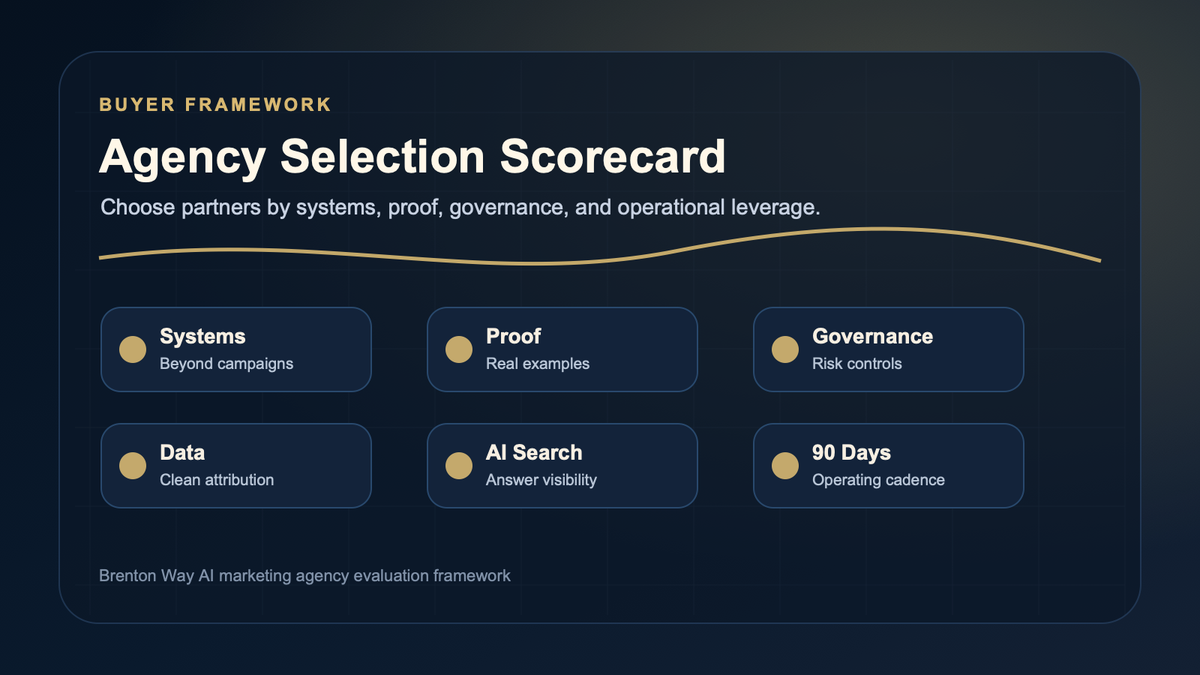
The maturity gap most brands are stuck in
Here's the uncomfortable truth behind the hype: almost nobody has actually figured this out yet. That's not a reason to wait — it's the reason the right partner is worth so much.
In Supermetrics' 2026 Marketing Data Report (435 marketers), only 6% said they've fully embedded AI into their workflows, even though 80% feel pressure to adopt it — and 89% of that pressure comes straight from the C-suite and board (Supermetrics, 2026). Most teams are using AI, but for the shallow stuff:
AI usage clusters on content (87%), drops off for analytics (39%), and falls again for automation (33%). In other words, most teams use AI to write faster — not to build systems that optimize spend or close the loop on revenue. Meanwhile 52% don't own their data strategy, and ROI is the number-one pain point: 45% rank it their top challenge, 40% can't prove it, and 61% are required to justify AI spend anyway (Supermetrics, 2026).
This is the gap a capable AI marketing agency closes. The reader's problem isn't "we need more AI content." It's "we're under pressure to show AI is working, and we don't have the systems to prove it." Solving that is a systems job, not a tools job.
For buyers, the practical requirement is simple: choose a partner that can integrate machine learning, predictive analytics, marketing automation, and real-time reporting into the customer experience. A traditional digital marketing agency may run campaigns; the right AI partner builds the decision layer that shows marketing teams what to do next and why.
Systems vs. campaigns: what a great AI marketing agency actually builds
A strong AI marketing agency builds compounding assets — systems that get more valuable every month — instead of disposable campaigns that reset to zero the moment spend stops. This is the heart of how to evaluate one. Below are the system categories that separate builders from tinkerers, with examples of what each looks like in practice.
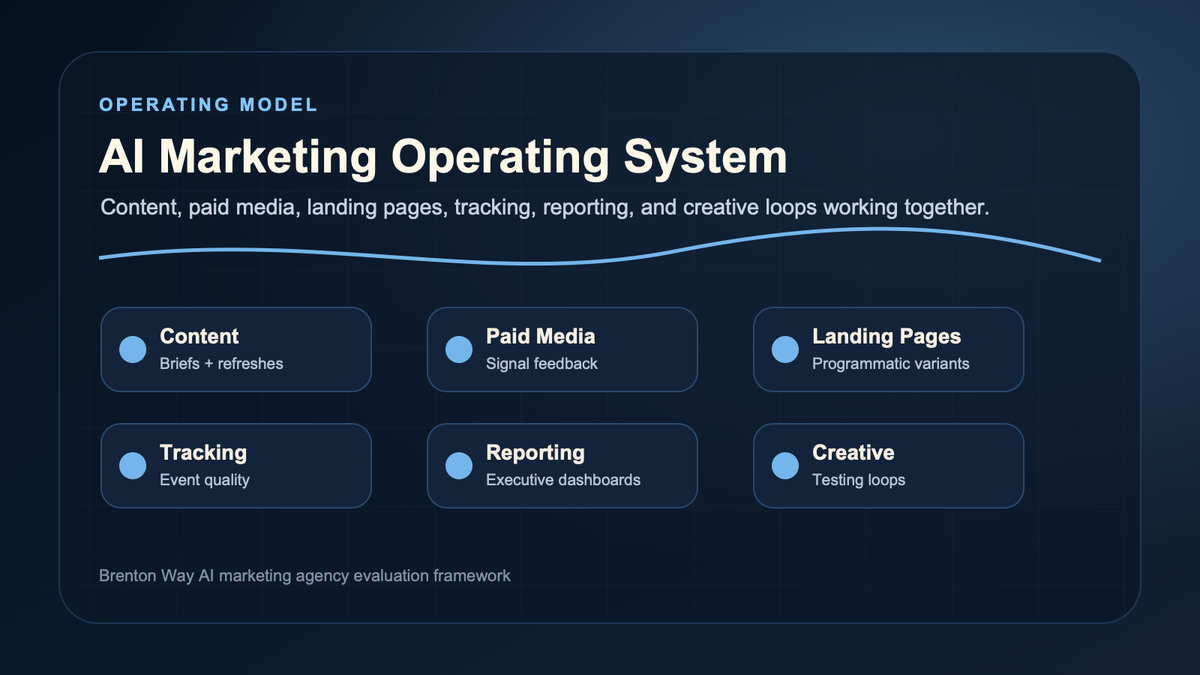
Content and SEO optimization systems
The best agencies don't just write content with AI — they build a pipeline that scores every page against the live competitive set and real search intent before it ships, then keeps it fresh as rankings move. Content stops being a one-time deliverable and becomes a managed, improving asset. This matters more now that AI-generated search results reward genuinely authoritative, well-structured pages over keyword-stuffed filler. (For the strategy shift here, see the rise of AGI SEO.)
Programmatic landing-page systems
Instead of hand-building pages one at a time, a systems-minded partner creates an engine: one content model that spins up location-, service-, or audience-specific landing pages on demand. Weeks of manual page builds collapse into same-day publishing — and every new page inherits the system's SEO structure and tracking automatically.
For a premium cosmetics brand, we found dedicated landing pages converted paid traffic at 2× the rate of standard product pages. So we built a landing-page system that spins up a tailored page per campaign — rather than sending expensive paid clicks to a generic page and hoping.
For a multi-location dermatology group, we built a per-location campaign and landing-page system across four markets. It surfaced the breakout market at a$7.89 cost-per-lead — and flagged where over-reliance on a single keyword had pushed another market's cost-per-lead from$16 to $58, so budget moved to where it actually compounded.
Conversion tracking and attribution infrastructure
This is the least glamorous and most valuable system an agency can build. Browser-based, last-click tracking is increasingly broken by privacy changes and ad blockers. A modern partner implements server-side, single-origin conversion tracking so the data feeding your ad platforms is clean and durable — which means budget follows the campaigns that actually drive revenue, not the ones that merely got the last click.
For a beauty brand running paid across several channels, single-origin server-side conversion tracking replaced last-click noise with clean attribution — so spend followed the ad sets that drove booked revenue.
Automated reporting and creative analysis
AI's real leverage in reporting isn't prettier dashboards — it's speed of insight. A good system compresses creative and performance analysis from days to hours, surfacing the winners and the silent problems a human scanning a dashboard would miss. The team spends its time acting on insight instead of assembling it.
AI-accelerated creative production
Generative tools let a strong creative team produce more variations, test more angles, and iterate faster — without losing the brand judgment and positioning that AI can't do. The system is the production pipeline; the humans are the taste. Done right, you get volume and quality, which is exactly what high-velocity paid social demands.
Each of these maps to a service discipline —search/SEO, paid media, content marketing, conversion optimization, and creative studio — but the point isn't the channel. It's that a great agency turns each one into a system you keep.
That distinction matters most in performance marketing: AI should help prioritize budget, creative testing, landing-page variants, and search engine optimization opportunities in one operating loop. If the agency cannot explain how it will use AI to improve those marketing strategies week by week, it is probably selling output instead of leverage.
The Compounding Systems Test: how to choose an AI marketing agency
The fastest way to evaluate any AI marketing agency is to ask one question: when this engagement ends, do we keep an asset — or are we left with nothing? We call this the Compounding Systems Test, and it comes down to five checks. Run every agency you're considering through all five.
Use this as your choose-the-right filter before comparing proposals: the best AI marketing agencies can connect strategy, software, algorithmic insight, and human judgment into a system you own. Ask for the workflow map, the handoff documentation, the measurement plan, and the named owner for every automated decision.
| Check | What good looks like | Red flag |
|---|---|---|
| 1. Ownership | You keep the content, accounts, data, and systems — full stop | The agency owns your ad accounts, domain, or data "for convenience" |
| 2. Proof of build | They can show systems they engineered, not just dashboards | "AI-powered" means one ChatGPT integration |
| 3. Measurement | Server-side, auditable attribution you can verify | Last-click vanity metrics and screenshots |
| 4. AI-search readiness | A clear answer-engine (AEO/GEO) strategy | They've never heard of AI Overviews or Perplexity |
| 5. Compounding model | Month 12 delivers more than month 1 for the same fee | Every month is a fresh batch of disposable work |
1. Ownership. This is non-negotiable and the most commonly violated. You should own your content, your ad and analytics accounts, your data, and any systems built for you. Regulators are paying attention too — the FTC's "Operation AI Comply" and SEC actions have put AI-washing and data practices on notice (2024). If an agency resists putting ownership in writing, walk.
2. Proof of build. Ask them to show you a system they engineered for a client — a workflow, a pipeline, an attribution setup — not a campaign screenshot. Genuine builders restructured how the work gets done. AI-washers added a tool and changed nothing underneath.
3. Measurement. Ask how they track conversions and attribute revenue. If the answer is last-click and platform-reported numbers, you'll never be able to prove ROI — which, remember, 40% of marketers already can't (Supermetrics, 2026). Durable, server-side measurement is the foundation everything else stands on.
4. AI-search readiness. Discovery is moving from the search results page to the answer itself. A 2026 G2 finding reported that 69% of buyers have switched a vendor based on AI-generated guidance — meaning whether an answer engine cites you now directly affects pipeline. Your agency needs a real AEO/GEO strategy, not a blank stare.
5. Compounding model. The tell of a systems agency: their output grows while your cost stays flat, because the systems do more of the work over time. A campaign shop charges the same for the same disposable output forever.
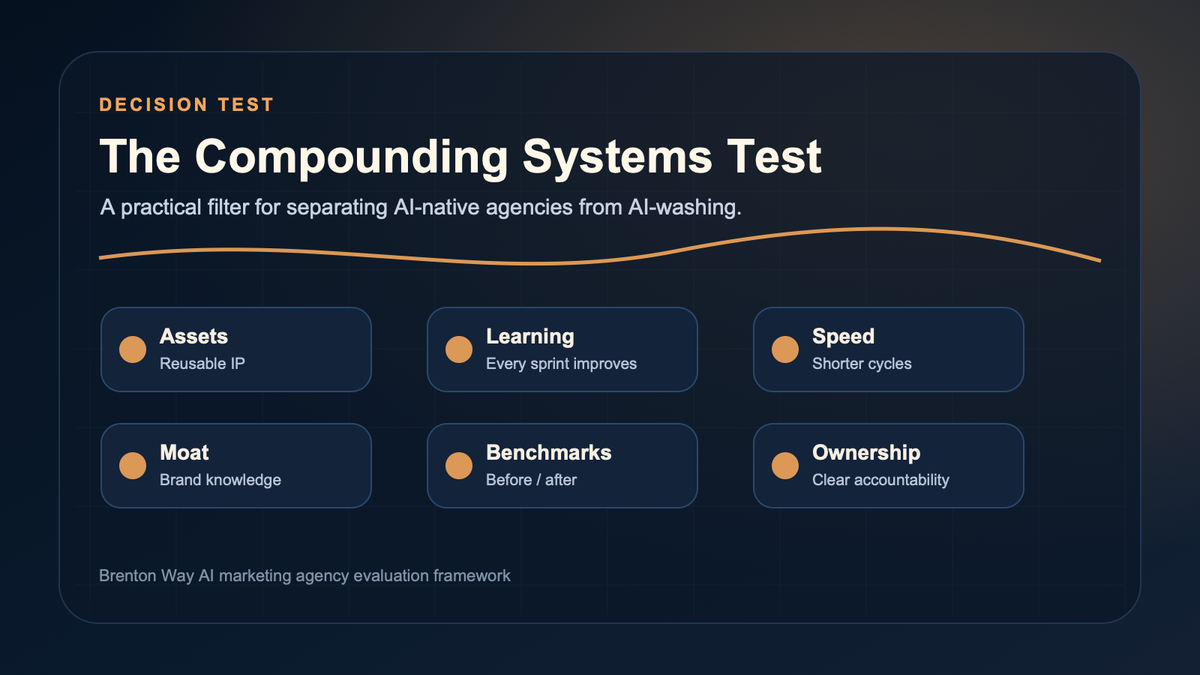
Red flags and AI-washing: how to spot a fake
AI-washing is when an agency markets sophisticated AI capabilities it doesn't actually have — usually a single ChatGPT integration dressed up as an "AI-native platform." Gartner's "agent washing" finding showed how widespread this is: of thousands of vendors claiming agentic AI, only around 130 were judged to be the real thing (Gartner, 2025). The same dynamic plays out in agency pitches. Watch for these signals:
- "AI-native" that's one tool deep. A real AI agency restructured its operations around systems. A fake added ChatGPT to the same old process. Ask what changed in how the work gets done — vague answers tell you everything.
- Guaranteed rankings or overnight results. No legitimate agency guarantees a #1 ranking or instant growth. This is the oldest red flag in marketing, now wearing an AI costume.
- Lock-in without benchmarks. Long contracts with no clear success metrics, and no baseline to measure against, are designed to make you hard to fire — not to make you successful.
- Won't name the team. If they won't tell you who actually works on your account — or it turns out to be AI output with no human owner — that's a problem when something goes wrong.
- You don't own your stuff. Covered above, worth repeating: if the contract doesn't give you ownership of content, accounts, and data, the engagement is a hostage situation, not a partnership.
A useful vetting habit, drawn from buyer-side guides like Hashmeta's 15-question framework (2026): make every agency answer "do you build proprietary systems, or resell tools?" and "what's your approach to answer-engine visibility?" The builders have crisp, specific answers. The AI-washers don't.
If you still need a market scan after this framework, compare it against our AI agency shortlist list — but use the list as a shortlist, not a substitute for the systems test.
What does an AI marketing agency cost?
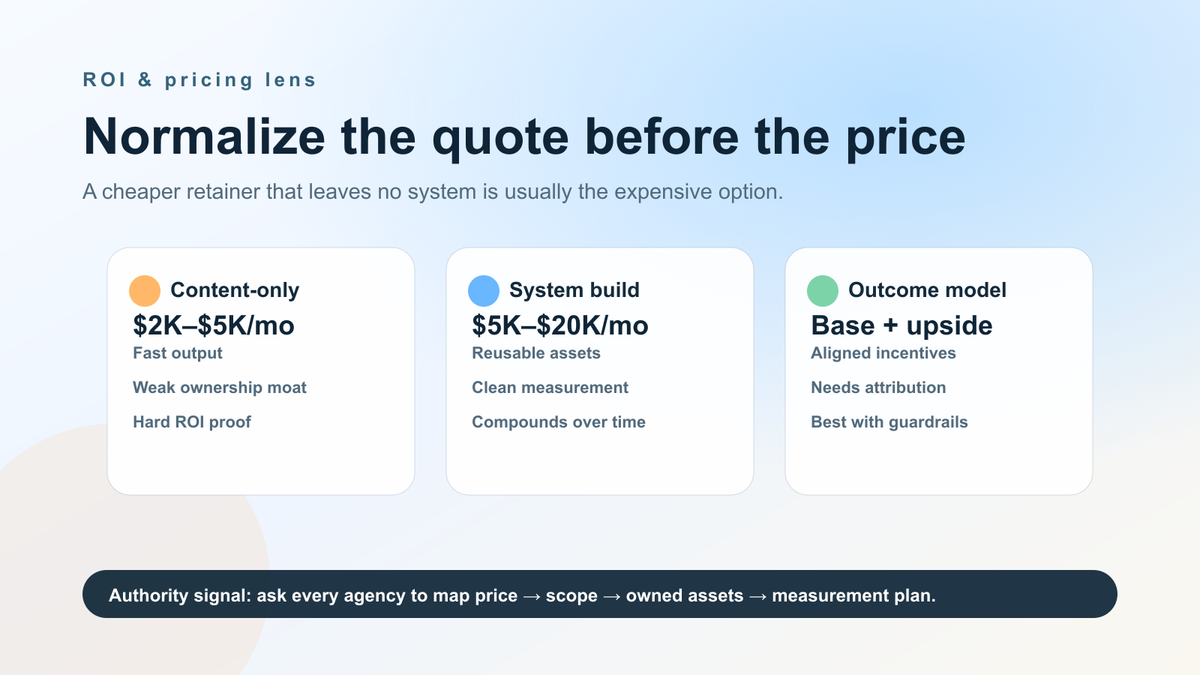
AI marketing retainers typically run $2,000–$20,000 per month, with search optimization services averaging around $3,200/month; smaller businesses cluster at $1,500–$5,000/mo and mid-market firms at $5,000–$25,000/mo (Digital Agency Network, 2026; OutreachZ, 2026). But the number on the invoice is the least useful part of the conversation, because scope varies wildly between agencies.
| Engagement | Typical monthly | Notes |
|---|---|---|
| SMB / single channel | $1,500–$5,000 | Basic AI services, one or two channels |
| Mid-market / multi-channel | $5,000–$25,000 | AI SEO + content + paid + analytics |
| Enterprise / comprehensive | $10,000–$50,000+ | Full-stack systems, custom build |
| AI SEO (specific) | $2,000–$20,000 (avg ~$3,200) | Often a line item within a larger retainer |
Why quotes aren't comparable. One agency's "$5,000 AI SEO" is another's content-only deliverable; a third bundles content, paid, CRO, analytics, and lifecycle automation into the same number. Always normalize on scope before you compare price. A cheap retainer that builds nothing durable is more expensive than a higher one that leaves you owning systems.
Pricing models you'll encounter
- Monthly retainer — still the default; best when scope is predictable.
- Project / flat fee — audits, migrations, one-time system builds.
- Performance-based — fees tied to leads or revenue.
- Hybrid — base retainer plus a performance bonus (the fastest-growing model).
- Productized / subscription — fixed-scope, fixed-price tiers.
There's a deeper shift worth understanding before you negotiate: AI is breaking hourly billing. When AI compresses a 20-hour deliverable into 5 hours, hourly pricing quietly cuts an agency's revenue ~75% for the same output — and roughly a third of agencies have already fielded explicit "AI discount" requests (Digital Applied, 2026). The market is moving toward outcome-based and productized pricing as a result. If an agency still bills you purely by the hour for AI-accelerated work, you may be paying for inefficiency.
How to actually measure ROI
Be realistic about what "ROI" means here, because the data says most organizations struggle with it. IBM's survey of 2,000 CEOs found only about 25% of AI initiatives delivered the expected ROI, and just 16% scaled enterprise-wide — with the barrier being organizational (culture, governance, workflow, data), not technical (IBM, 2025). The lesson for buyers: an agency that builds the systems and data foundations is solving the actual bottleneck, while one selling raw AI output is not.
A practical way to think about it is risk-adjusted ROI — discount projected gains by real-world failure rates (hallucinations, human overrides, model drift), and expect realistic payback in under two quarters for operational automation and under a year for build work (Movadex, viaCIO.com, 2026). To pressure-test your own numbers before committing budget, run them through our CAC payback calculator.
In-house vs. agency vs. AI tools: which is right for you?
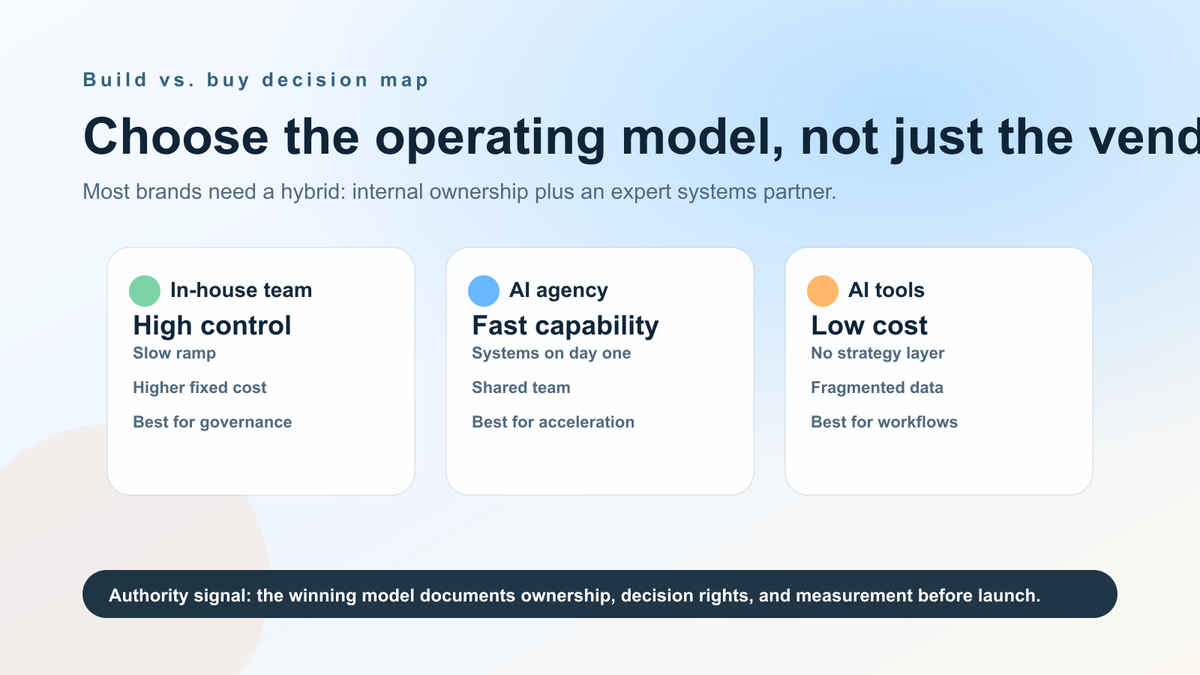
The honest answer: most mid-market brands end up with some blend, and the right mix depends on the systems you need and the speed you need them. Here's how the three options actually compare on cost and capability.
| In-house team | Agency | AI tools alone | |
|---|---|---|---|
| Annual cost | ~$348K–$652K (4–6 fully-loaded roles) | ~$24K–$60K (boutique) up to ~$600K (enterprise) | ~$3K–$12K/yr + ad spend |
| Time to value | 3–6 months to ramp | ~4–6 weeks | Days |
| Tooling | Paid on top of salaries | Bundled into the retainer | Bundled into subscription |
| Biggest gap | Hard to staff 6+ specialties; fixed cost | Split attention across clients | Weak on strategy, creative, positioning |
Building in-house gives you control but is expensive and slow. A fully-loaded 4–6 person team runs roughly$348,000–$652,000 a year before tooling, and takes months to ramp (BlueDash, 2026). You also have to find people who collectively cover SEO, paid, analytics, content, lifecycle, and creative — a tall order for one team.
Hiring an agency buys you a full skill set and systems on day one, typically live in 4–6 weeks, for a fraction of a headcount build. The tradeoff is shared attention — which is exactly why the ownership and systems checks above matter so much.
Relying on AI tools alone is cheap and fast, and it's tempting. But here's the part the tool vendors won't lead with: while AI-tool subscriptions are genuinely inexpensive, the eye-popping "AI is 70–85% cheaper" savings claims almost all come from companies selling the AI tools. Those numbers assume the tool fully replaces a team — which contradicts the near-universal finding that AI augments people; it doesn't replace strategy, creative direction, positioning, or relationships. Tools without a system and a strategist behind them produce more mediocre output, faster.
For many brands the smart middle is a hybrid: an in-house coordinator (~$80K–$120K) running an expert agency retainer (~$36K–$72K), for roughly$116K–$192K a year — far less than a full in-house build, with more capability than tools alone.
AI search is the new front door
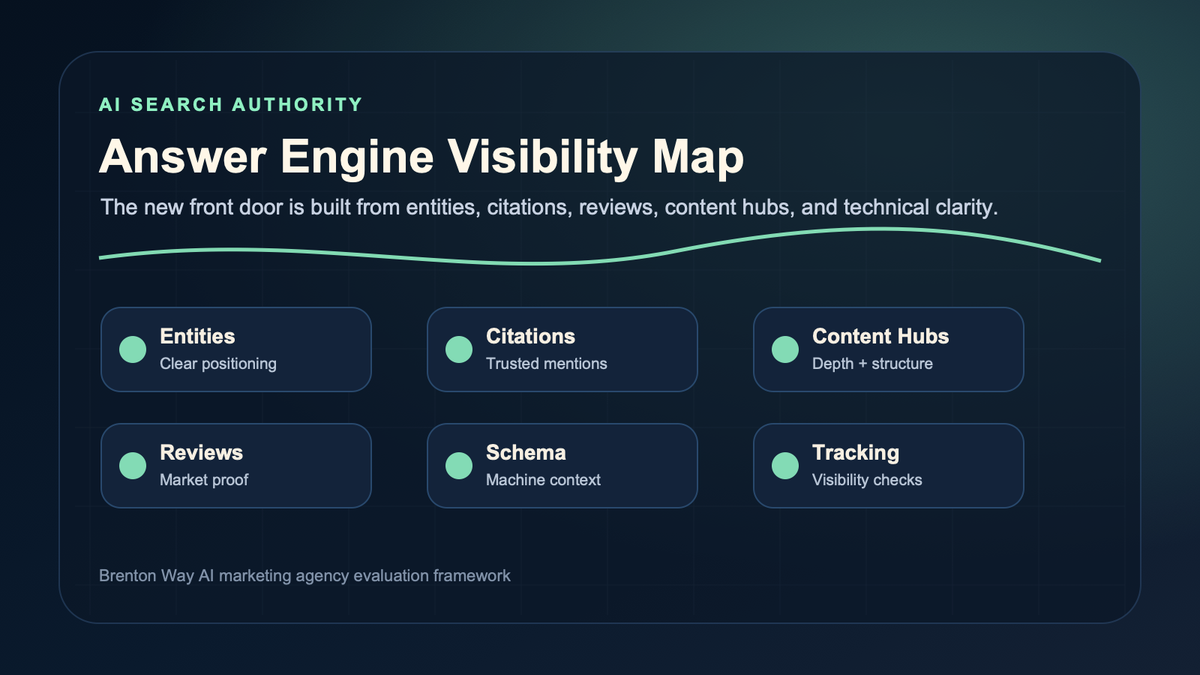
Answer engines are becoming the first place buyers form opinions — often before they ever click a link. AEO (answer engine optimization) and traditional SEO are converging into a single discipline focused on visibility before the click: being the source that ChatGPT, Perplexity, and Google's AI Overviews cite when they answer your buyer's question (HubSpot, 2026).
This isn't a side quest. With 69% of buyers switching vendors based on AI-generated guidance (G2, 2026), being absent from — or misrepresented in — AI answers is a pipeline problem, not a vanity one. A modern AI marketing partner plans for this deliberately: clean, well-structured content; clear, citable answers to real questions; and the technical signals that make a brand legible to machines as well as people. We go deeper on this in the rise of AGI SEO.
The brands that get cited in 2026 are the ones building the authority and structure now. The ones waiting for it to "settle" are ceding the front door.
What the first 90 days with a good AI agency look like
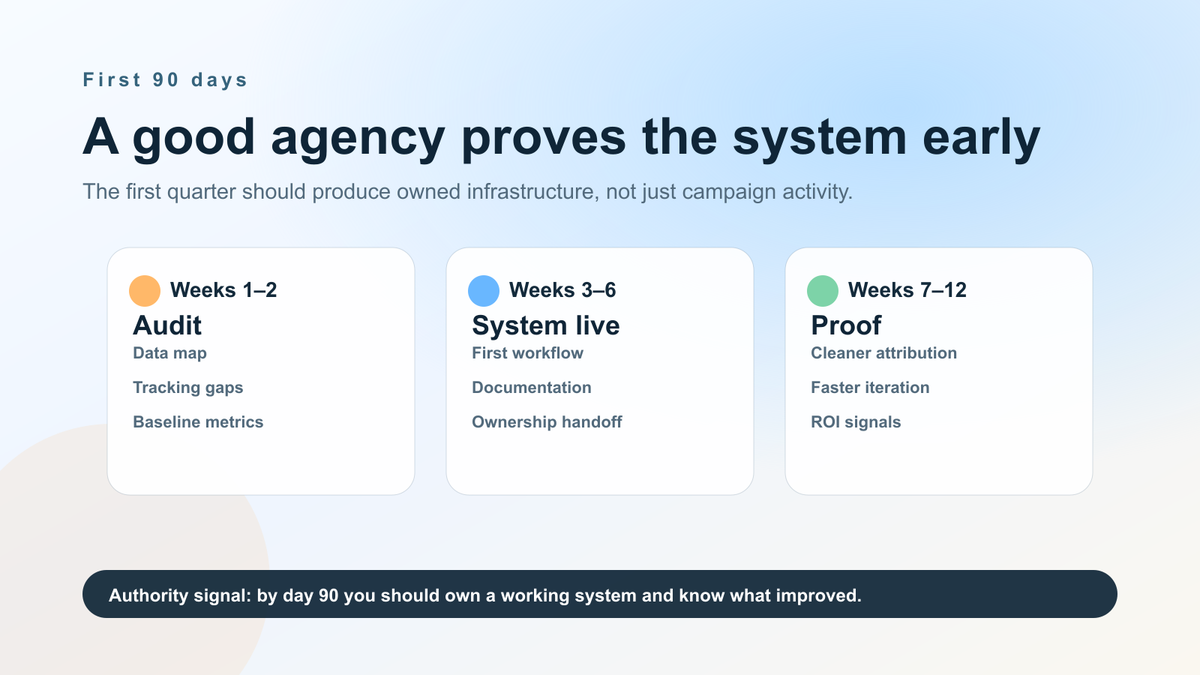
A strong engagement front-loads systems, not just deliverables. You shouldn't have to wait six months to see whether you made the right call. A healthy first 90 days usually looks like:
- Weeks 1–2 — Audit and foundations. They map your data, tracking, content, and channels — and tell you what's broken. Clean, server-side measurement gets prioritized first, because nothing downstream is trustworthy without it.
- Weeks 3–6 — First systems live. The highest-leverage system ships first — often content/SEO optimization or a landing-page engine — with ownership and documentation handed to you.
- Weeks 7–12 — Optimization and proof. Campaigns run on top of the systems, reporting shows real attribution, and you can see the compounding starting: faster launches, lower cost per result, clearer ROI.
If, at day 90, you don't own new systems and can't see cleaner numbers, you hired a campaign shop — not a systems builder.
For AI agencies working with business-to-business (B2B) or software as a service (SaaS) brands, proof should show up in real time: a large language model may summarize consumer behaviour, but the value comes from mathematical optimization across spend, personalization, and targeted advertising. Ask how those signals turn into a marketing strategy your team can inspect, override, and improve — not a black box that simply promises better outcomes. For benchmarks, pair this with our AI marketing statistics research before you sign.
The bottom line
The AI marketing agency you want isn't the one with the flashiest AI claims. It's the one that builds you systems you keep — content and SEO pipelines, programmatic landing pages, clean server-side measurement, automated insight — so your marketing gets cheaper and smarter every month, and so you're visible when AI answers your buyer's questions.
Three things to take into any vendor conversation: run them through the Compounding Systems Test, insist on ownership in writing, and normalize price on scope, not the headline number. Those checks address the value, cost, and control risks behind Gartner's forecast that over 40% of agentic AI projects will be canceled by the end of 2027.
Brenton Way builds these systems for growth-focused brands — and we'd rather show you than tell you. Book a consultation and we'll walk through what a compounding marketing system would look like for your brand.
Frequently Asked Questions
An AI marketing agency uses artificial intelligence to plan, produce, optimize, and measure marketing — and the best ones build durable systems (content pipelines, landing-page engines, server-side measurement) that a brand owns and keeps improving, rather than one-off campaigns.
It runs the same disciplines as a traditional agency — SEO, paid media, content, social, CRO, creative — but uses AI to do them faster and to build automated systems underneath them. That includes content optimization, programmatic landing pages, attribution infrastructure, and automated reporting.
Most retainers run $2,000–$20,000 per month, with search optimization services averaging around $3,200/month. Small businesses typically pay $1,500–$5,000/mo and mid-market firms $5,000–$25,000/mo (Digital Agency Network, 2026). Always compare on scope, since quotes vary widely.
It can be — if it builds you systems you own rather than disposable output. Given that only ~25% of AI initiatives hit expected ROI and the barrier is organizational, not technical (IBM, 2025), the value comes from an agency that fixes the systems and data foundations, not one selling raw AI content.
A traditional agency may use AI tools to work faster; an AI-native agency restructures its operations around AI-enabled processes and builds that infrastructure into your marketing. The test is whether you keep a compounding asset at the end, or just a stack of completed campaigns.
Run each one through five checks — ownership, proof of build, measurement, AI-search readiness, and a compounding model — and ask them to show a system they engineered (not a dashboard). If they resist putting data and account ownership in writing, walk.
No. AI tools accelerate execution, but they don't replace strategy, creative direction, brand positioning, or relationships. The strongest setups pair automation with human strategists — tools alone tend to produce more mediocre output, faster.
AI-washing is marketing AI capabilities a vendor doesn't really have — usually one ChatGPT integration dressed up as an "AI-native platform." Gartner found only ~130 of thousands of vendors claiming agentic AI were the real thing (2025). Avoid it by asking what actually changed in how the work gets done.
Tags
Let's Grow Your Brand With Us
Book a free consultation and get a custom growth strategy tailored to your business.
Book Free ConsultationGet marketing insights in your inbox
Join our newsletter for the latest digital marketing tips and strategies.
By subscribing, you agree to our Privacy policy .

About the author
Jonathan SaeidianHead of Strategy at Brenton Way
Jonathan Saeidian is the founder of Brenton Way, Bridge, and Growth Virality, where he builds measurable growth marketing systems for startups, scaleups, and enterprise teams.


