AEO Statistics for 2026: AI Search, Zero-Click Trends, and Optimization Strategy

TL;DR
Review the AEO statistics shaping 2026: AI search growth, Google AI Overviews, zero-click behavior, citations, AI referrals, adoption, trust, and how brands should adapt.

Ask AI about this
Get an AI-powered summary of this article
Table of Contents
Your customers are no longer only searching Google, scanning ten blue links, and deciding which website to click.
They are asking ChatGPT which company to trust. They are using Perplexity to compare options. They are seeing Google AI Overviews before organic results. They are relying on AI summaries to narrow down what to buy, who to hire, and which brands deserve a closer look.
That shift does not make SEO irrelevant. It changes what visibility means.
For years, the goal was to rank and win the click. In 2026, brands also need to be cited, summarized, and recommended inside the answer itself. That is where answer engine optimization, or AEO, comes in.
AEO is the practice of making your brand easier for AI-assisted search systems to crawl, understand, trust, quote, and recommend. It sits at the intersection of technical SEO, entity clarity, source-backed content, digital PR, structured information, and measurement.
The statistics below show why AEO is moving from a niche SEO conversation into a serious growth priority. AI search is growing quickly. Zero-click behavior is increasing. AI referrals are still small, but often high-intent. Third-party mentions and earned citations are becoming more important. And many brands still do not know whether they are visible in AI search at all.
Key AEO Statistics for 2026
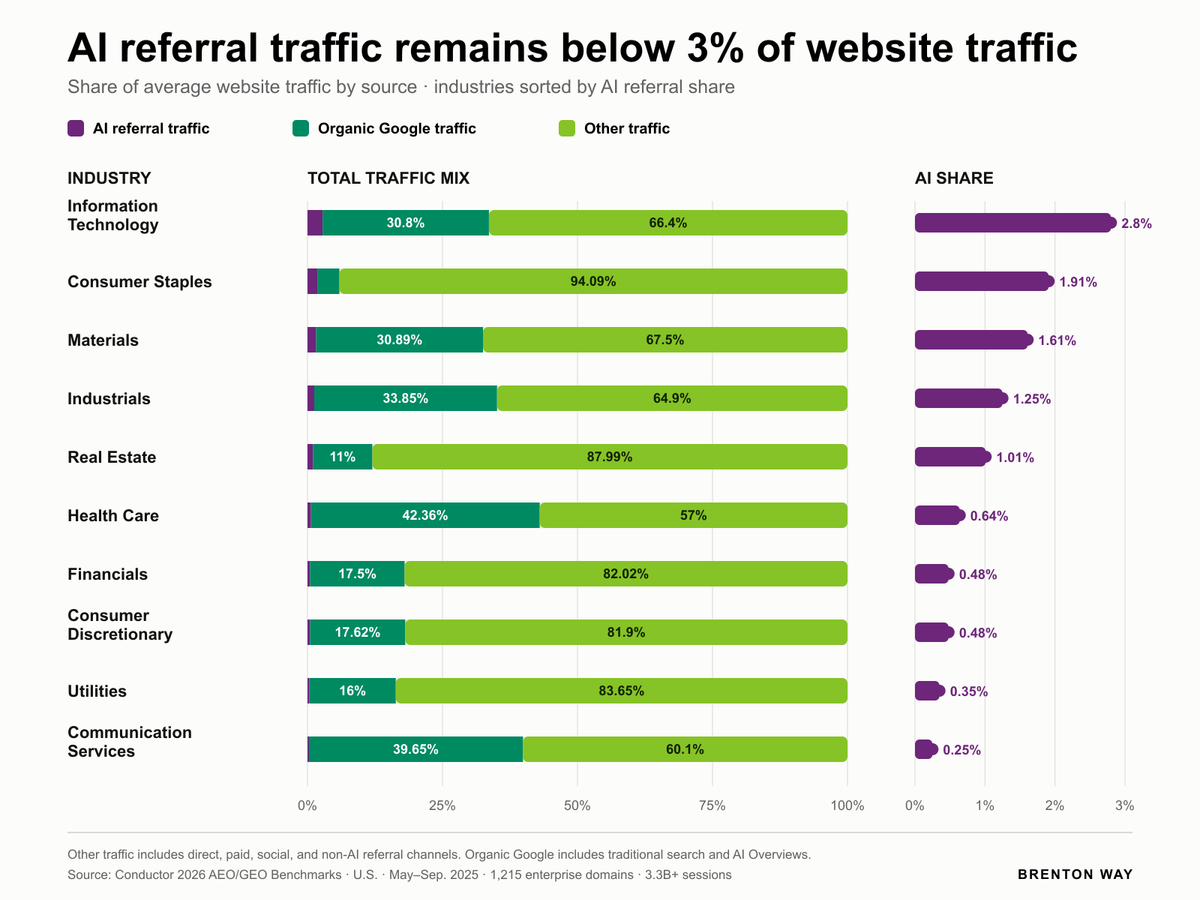
Source: Conductor, 2026 AEO/GEO Benchmarks. U.S. monthly traffic averages, May–September 2025; 1,215 enterprise customer domains and more than 3.3 billion sessions. Organic Google includes AI Overviews and AI Mode because analytics does not separate those referrers.
- AI search is becoming mainstream, but Google still controls enormous discovery volume.
- Google AI Overviews and AI summaries are changing click behavior, especially on informational queries.
- Being cited in an AI answer is not the same as ranking in the organic top 10.
- Third-party mentions, earned media, and entity consistency matter more in AI search than most brands realize.
- AI referral traffic is often low-volume, but the visitors can be much further along in the buying journey.
- AEO is not a hack. It is the result of stronger technical SEO, clearer content, better proof, and broader authority across the web.
What Is Effective AEO?
Answer engine optimization is the process of optimizing your brand, website, and external authority signals so answer engines can confidently include you in AI-generated responses.
That includes platforms and experiences such as:
- Google AI Overviews and AI Mode
- ChatGPT Search
- Perplexity
- Gemini
- Claude-assisted research workflows
- Bing Copilot
- Voice and multimodal AI search experiences
Traditional SEO focuses on rankings, traffic, and organic search visibility. AEO focuses on whether AI systems can understand your brand and cite it when a user asks a question. For a deeper look at how this is playing out across the industry, our breakdown of how AI search is reshaping marketing is worth reading first.
In practice, the two overlap heavily. A site with weak crawlability, thin content, unclear positioning, and no external proof will struggle in both SEO and AEO. But AEO adds a different layer: your brand has to be understandable beyond your own website. AI systems often triangulate across third-party sources, mentions, reviews, structured data, social proof, and trusted publications before deciding what to include in an answer.
AEO vs Traditional SEO vs GEO
SEO, AEO, and GEO are connected, but they are not identical.
SEO is about improving organic visibility in search engines. The classic goal is to rank higher and earn more qualified clicks from search results.
AEO is about appearing inside direct answers. The goal is not only the click. The goal is to become one of the brands or sources an answer engine trusts enough to cite, summarize, or recommend.
GEO, or generative engine optimization, usually refers to optimization for generative AI platforms such as ChatGPT, Gemini, Claude, and Perplexity. AEO is broader because it includes answer experiences inside traditional search engines, including Google AI Overviews and AI Mode.
For a marketing team, the practical takeaway is simple: keep doing strong SEO, but structure your content and authority signals so AI systems can extract, verify, and reuse your expertise.
AEO Statistics for 2026
AI Search Engine Growth Statistics
- ChatGPT passed 900 million weekly active users in 2026, up from roughly 400 million in 2025. AI search is no longer a side behavior for early adopters. It is becoming a mainstream discovery habit.
- Google AI Mode surpassed 1 billion monthly active users globally as of May 2026. Google is not sitting outside the AI search shift. It is building AI directly into the search experience.
- Google AI Overviews now reach more than 2.5 billion users monthly across more than 200 countries. If your customers use Google, many of them are already seeing AI-generated summaries before they reach traditional organic results.
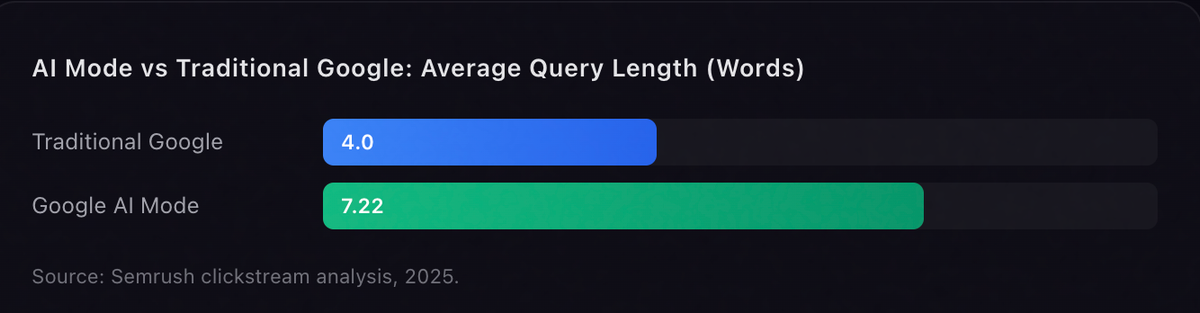
- The average AI Mode query is three times longer than a traditional search query. People do not use AI search the same way they use keyword search. They ask full questions, add context, compare options, and expect the system to synthesize a useful response.
- Traffic from generative AI platforms grew 796% year over year in one reported analysis. The base is still small compared with Google organic traffic, but the growth rate is too large to ignore.
- Another AI traffic analysis found referral traffic from AI platforms grew 527% year over year. The exact number varies by dataset, but the directional trend is consistent: AI-assisted discovery is sending more measurable traffic back to websites.
- Similarweb reported that total AI referral visits to websites grew more than 3x between September 2024 and September 2025. That matters because it shows AI platforms are not only replacing clicks; they are also becoming a new referral layer.
- The share of ChatGPT answers that include citations rose from 0.6% to 2.8% between January and August 2025, according to Similarweb. Citations are still not universal, but they are becoming more common as AI search experiences mature.
- Google still processes roughly 8.5 billion searches per day. The point is not that Google is dead. The point is that Google itself is becoming more AI-assisted, while users also search through AI-native platforms.
Zero-Click Search Visibility and AI Overview Statistics
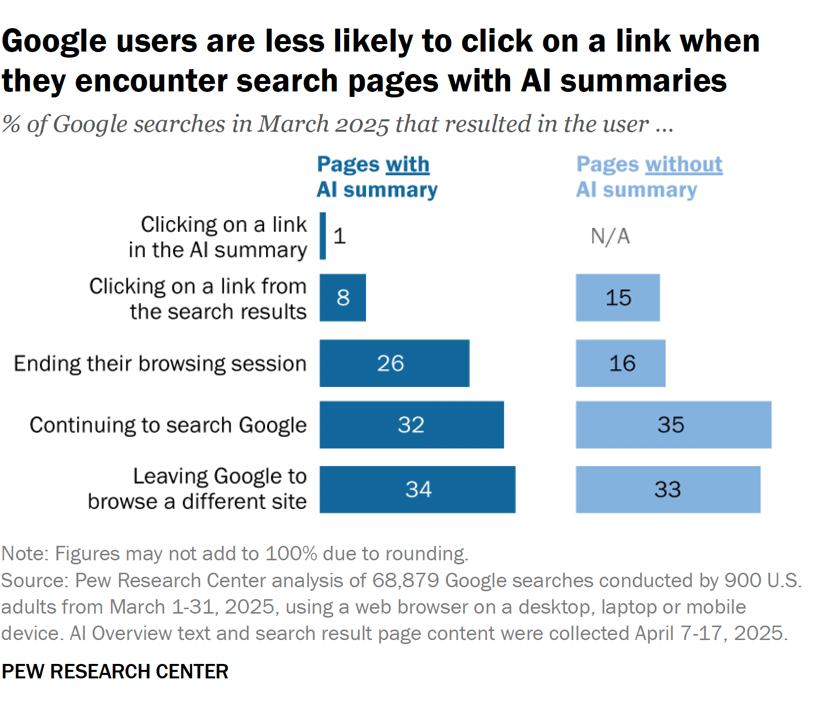
- Pew Research Center found that 18% of Google searches generated an AI summary in its March 2025 behavioral analysis of 68,879 searches. This is important because it is measured behavior, not just a survey of what users claim to do.
- Pew also found that when an AI summary appeared, users clicked a traditional result in just 8% of visits, compared with 15% of visits when no AI summary appeared.
- Additionally, Pew found that users clicked a link inside the AI summary itself only 1% of the time. That is why the citation matters. Even if the AI answer does not send a large click volume, being named in the answer can shape trust and consideration.
- The presence of a Google AI Overview correlates with a 58% lower click-through rate for the top-ranking organic result, according to Ahrefs analysis of 300,000 keywords.
- Ahrefs also found that position-one CTR for AI Overview keywords fell from 0.073 to 0.016 between December 2023 and December 2025. Ranking first is still valuable, but it is not the same guarantee of traffic when an AI answer sits above the result.
- In another user behavior analysis, 26% of users who encountered an AI summary ended their browsing session entirely, compared with 16% for results without one. AI summaries are not just moving clicks around; they are often ending the search journey earlier.
AI-driven Citation and Source Behavior Statistics
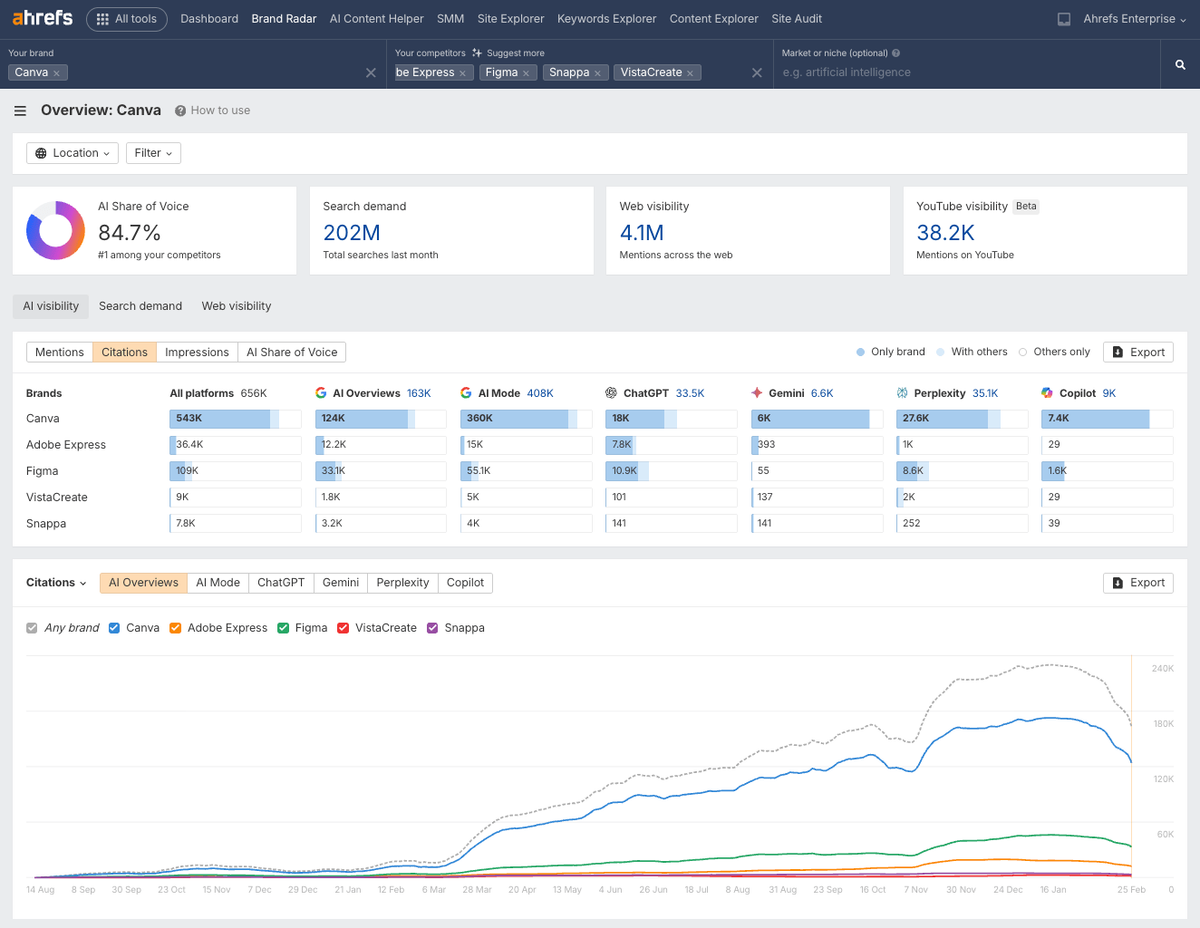
- Only 17% to 38% of pages cited in AI Overviews also rank in the organic top 10. AEO and SEO overlap, but AI visibility is not a perfect mirror of organic rankings.
- A brand's own website accounts for only 5% to 10% of the sources AI search references in some analyses. Owned content matters, but it is not enough on its own.
- As much as 94% of AI citations may come from earned, non-brand-owned sources. AI systems often rely on third-party publications, industry resources, comparison pages, reviews, and other external proof when forming answers.
- Brand web mentions correlate 3x more strongly with AI Overview visibility than backlinks do in one analysis. Backlinks still matter for SEO, but AI visibility appears to reward broader brand presence and entity reinforcement.
- Distributing content across a wider range of publications can increase AI citations by up to 325%. If your expertise only lives on your own blog, you are limiting the number of places AI systems can learn about and verify your brand.
- Pages that go more than three months without an update are over 3x more likely to lose AI visibility. Freshness matters because AI systems need current, reliable information to cite.
AEO Conversion, Referral, and Commerce Statistics
- AI-referred visitors converted at an average of 14.2% in one analysis, compared with 2.8% for Google organic traffic. AI referral volume may be smaller, but the intent can be much higher.
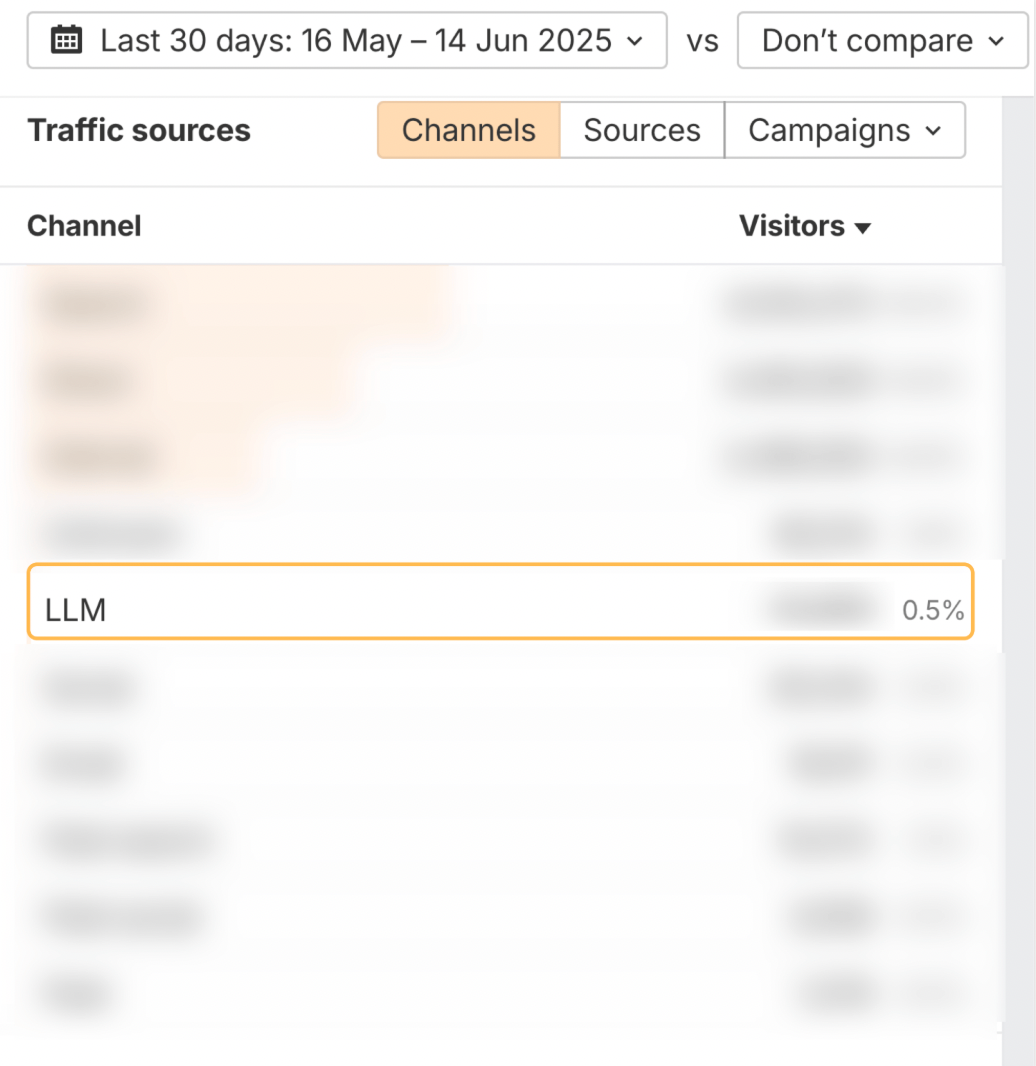
- In one Ahrefs analysis, AI search visitors generated 12.1% of signups while representing only 0.5% of total traffic. That suggests AI referrals can punch far above their weight when the user arrives after receiving a recommendation.
- Salesforce reported that AI and AI agents influenced 20% of online retail sales during the 2025 holiday season, supporting $262 billion in revenue through personalized recommendations and engagement. AI is not just changing research behavior; it is influencing buying behavior.
- Adobe Analytics reported that traffic to U.S. retail sites from generative AI tools jumped 693% year over year during the 2025 holiday season, with Cyber Monday up 670%. The growth is dramatic, even if it starts from a smaller base.
- Adobe consumer research found that 39% of U.S. consumers had already used generative AI for online shopping, and 53% planned to use it in 2025. Product discovery is becoming more conversational.
- Bain reported that 30% to 45% of consumers already use generative AI for product research, while about 50% remain cautious about letting AI agents complete purchases autonomously. Buyers are comfortable using AI for consideration before they fully trust it for final purchase execution.
AEO Adoption, Investment, and Readiness Statistics
- Salesforce reported that 88% of marketers have already begun optimizing for AI-generated responses, and 85% say AI is reshaping their SEO strategy.
- 75% of senior marketers whose organizations invested in AI report positive ROI. AI investment is not automatically successful, but many teams that invest seriously are seeing value.
- HubSpot reported that 65% of senior marketers plan to increase investment in AI and automation tools.
- Gartner reported that CMOs allocate an average of 15.3% of marketing budgets to AI initiatives, while the most AI-ready organizations allocate 21.3%.
- Gartner also reported that only 30% of CMOs report mature or fully developed AI readiness, even though 70% call becoming an AI leader a critical goal. The gap is not interest. The gap is execution.
- Only 27% of marketers are actively tracking their AI search performance. Large brands may have budget, but many still lack AEO measurement infrastructure.
- About 73% of businesses are effectively invisible in AI search in part because AI crawlers can be blocked by default bot-protection settings. Some brands have an AI visibility problem before the content strategy even begins.
- Brands implementing full AEO programs report ROI improvement in AI citation. AEO is not one tactic. It is a system of content, technical access, structured data, off-site proof, and ongoing monitoring.
- 97% of digital leaders reported a positive impact from AEO in 2025, and 94% of digital marketing leaders planned to increase AEO investment in 2026. The teams already investing in AEO are not treating it as a passing experiment.
AI Trust and Consumer Behavior Statistics
- Gartner found that 53% of U.S. consumers distrust or lack confidence in the reliability and impartiality of AI search results and summaries.
- The same Gartner study also found that 61% of consumers wish they had an option to toggle AI summaries on or off. AI answers are influential, but user trust is still fragile.
- A global KPMG and University of Melbourne study found that only 46% of people globally are willing to trust AI systems. It also found that 70% believe AI regulation is needed.
These trust statistics matter for AEO because being visible is not enough. Brands also need verifiable proof, clear claims, strong sources, and a content experience that earns confidence after the AI recommendation.
AEO Market Size and Annual Spending
There is no defensible, independently auditable global market-size estimate for AEO alone as of 2026. Public sources measure adoption and budget allocation, but they do not isolate AEO software revenue, services revenue, and in-house labor. The earlier $1.2 billion–$2 billion estimate has been removed because its category boundaries and model could not be verified.
How large is the AEO market?
The public evidence supports a budget-allocation benchmark, not a global dollar total. In Conductor’s 2025 U.S. survey of more than 250 enterprise digital leaders at companies with at least 500 employees across more than 12 industries, respondents allocated an average 12% of digital marketing budgets to AEO/GEO. The survey also found that 94% planned to increase investment in 2026.
This is a vendor survey of digitally mature leaders who directly manage AEO or SEO. It does not disclose each company’s dollar budget or a consistent accounting boundary, so the 12% allocation cannot be converted into worldwide market revenue.
Source: Conductor, The State of AEO/GEO in 2026
How much is spent annually on AEO software and services?
No transparent public source reports separate annual totals for AEO software and AEO services. A precise combined figure would blend categories that are purchased and measured differently.
AEO software revenue: prompt monitoring, citation analytics, content optimization, and technical auditing tools. No audited standalone category total is public.
AEO services and consulting: strategy, content, technical implementation, measurement, and digital PR. These costs are commonly bundled into SEO, content, or agency retainers.
Broader AI-search and SEO budgets: useful context, but not an AEO revenue estimate because they include traditional SEO and general AI tooling.
Marketer budget allocations: survey percentages describe intent or planned allocation, not realized vendor revenue. In-house labor is usually omitted.
Until a source publishes a base year, geography, included categories, company and vendor sample, revenue inputs, and modeling method, annual AEO software-and-services spending should be reported as unknown rather than estimated from proxy markets.
Exclusive Brenton Way Analysis: AI Visibility Is Volatile and Citations Do Not Guarantee Recommendations
Brenton Way analyzed 851 successful AI-search responses across eight monitoring runs from August 7 through August 31, 2026. Each run tested the same 18 commercial agency queries in U.S. English three times per supported surface on grounded Gemini and Perplexity Search.
Brenton Way appeared by name in 45 responses, a 5.3% mention rate. A Brenton Way URL was cited in 30 responses, a 3.5% citation rate. The run-level mention rate ranged from 1.0% to 9.6% even though the prompt set and repetition structure stayed constant.
A citation is not the same as a recommendation. In multiple runs, Perplexity used Brenton Way articles as sources without naming Brenton Way among the recommended agencies. Measure citations, explicit mentions, recommendation position, and consistency separately instead of collapsing them into one AI visibility score.
Methodology and inclusion criteria
The analysis includes eight runs collected on August 7, 10, 14, 17, 21, 25, 28, and 31, 2026. Brenton Way’s unchanged v2 panel used 18 commercial agency prompts, en-US, with three repetitions per supported surface. Gemini used gemini-2.5-flash with search grounding; Perplexity used sonar search. Failed and unsupported observations were excluded from the denominator. ChatGPT Search was not represented because the required API credential was unavailable.
Mentions required “Brenton Way” in retained answer text. Citations required a brentonway.com URL in retained citation metadata. The totals are direct sums of Brenton Way’s own monitoring runs, not modeled or extrapolated results. That private prompt set, repeated observations, citation metadata, and aggregation make this an exclusive Brenton Way analysis.
Limitations
This is a single-brand, 18-prompt commercial-agency panel, not a representative sample of all brands, industries, or AI queries. Provider output is stochastic and can change with the model, retrieval index, location, or time. The analysis documents volatility and the difference between citations and mentions; it does not show that a content change caused visibility to rise or fall.
Understanding Top AEO Statistics
The data points in this article all point in the same direction: search visibility is becoming more compressed, more conversational, and more proof-driven.
A user may still begin in Google, but the experience is no longer just a list of pages. Google may summarize the answer first. ChatGPT may produce a recommendation list. Perplexity may cite a few sources and skip the rest. Gemini may synthesize product or service options from multiple pages. AI agents may soon complete more of the evaluation process before a buyer ever fills out a form.
That creates five practical changes for growth teams.
1. Stop measuring only clicks
Clicks still matter. Revenue still matters. Organic sessions still matter. But if AI Overviews and answer engines reduce click volume, you need a visibility layer that captures whether your brand is being mentioned, cited, and recommended.
For AEO, track metrics such as:
- Share of voice in AI answers
- Brand mentions by platform
- Citation frequency
- Sentiment of AI-generated responses
- Whether your competitors appear more often than you
- AI referral traffic and assisted conversions
- Crawl access for Google, Bing, and relevant AI bots
2. Ensure visibility in AI answers
If nearly half of AI citations can come from the first 30% of a page, then long, vague introductions are expensive. Answer the core question directly near the top. Then expand with examples, proof, nuance, and strategy.
AEO-friendly content marketing often includes:
- Short definitions
- Tables
- Bullet lists
- Direct comparison sections
- FAQs
- Source-backed statistics
- Clear service or entity descriptions
- Authoritative summaries before deeper explanation
This does not mean writing robotic content. It means respecting the reader's time and making your expertise easier to extract.
3. Build authority beyond your own site
If AI systems depend heavily on earned and third-party sources, then your owned blog cannot do all the work. You need external proof.
That can include:
- Digital PR
- Thought leadership placements
- Partner profiles
- Podcasts and interviews
- Reviews and ratings
- Case study mentions
- Industry directories
- Comparison pages
- Research reports
- Expert quotes in relevant publications
AEO rewards brands that are easier to verify across the web.
4. Keep content fresh to keep ranking
AI search is especially sensitive to stale information because users expect current answers. If your key articles, service pages, statistics, and case studies have not been refreshed in months, you are increasing the risk that AI systems cite newer competitors instead.
For important AEO pages, build a quarterly refresh process:
- Update statistics and dates
- Replace weak or outdated sources
- Add new FAQs from sales calls and search data
- Improve internal links
- Add new third-party proof
- Recheck schema markup for search visibility and crawl access
- Monitor whether AI answers changed after the update
5. Treat AEO as a growth system, not a content trick
The brands that win in AI search will not be the ones adding a few keywords to blog posts. They will be the ones building AI marketing systems that connect technical access, content quality, brand authority, entity clarity, analytics, and digital PR.
AEO works best when it is connected to the broader marketing operation: SEO, paid media, lifecycle, sales enablement, CRO, and analytics.
5 AEO Trends to Watch in 2026
1. Google is not going away, but AI engines are changing how Google works
The lazy version of the AI search conversation is “Google is dead.” That is not true. Google still processes billions of searches per day, and it remains one of the most important discovery channels in the world.
The real shift is that Google itself is becoming more answer-driven. AI Overviews, AI Mode, query fan-out, and AI-assisted summaries all change what users see before they click.
So the strategic question is not whether to abandon SEO. It is whether your SEO is strong enough to survive when search becomes more conversational, more summarized, and more selective about which sources it cites.
2. Agentic AI will influence vendor selection
As AI agents become more useful, buyers will ask them to compare vendors, summarize reviews, create shortlists, and explain tradeoffs. This matters for service businesses because the evaluation journey may happen before a prospect visits your site.
If an AI agent cannot understand what your company does, who you serve, where you are credible, and why you are different, you may not make the shortlist.
3. Proprietary research will become a citation moat
Generic advice is easy to copy. Proprietary data is harder to replace.
Brands that publish original benchmarks, surveys, customer insights, industry reports, and performance data give AI systems something unique to cite. That is especially valuable in crowded categories where many competitors publish similar service pages and blog posts.
For Brenton Way, this is why AI visibility audits, original client-side insights, and industry-specific marketing benchmarks can become more than lead magnets. They can become citation assets.
4. AI referral traffic will stay smaller than organic, but higher intent
The most important AI referral trend is not volume by itself. It is intent.
A person who lands on your site after an AI system recommends your brand may already have compared alternatives, read a summary, and decided you are worth evaluating. That can make the traffic more valuable than a larger pool of generic organic visitors.
The right way to think about AI referrals is not as a replacement for SEO traffic. Think of them as a high-intent layer inside a broader discovery system.
5. Multimodal AEO is coming
AI search is moving beyond text. Users are asking questions with images, video, audio, screenshots, and documents. Search systems are becoming more capable of interpreting visual and multimedia content.
That means AEO will eventually include more than written articles. Brands will need clear image alt text, video transcripts, structured product information, visual proof, diagrams, and multimedia assets that reinforce the same entity and expertise signals as the written page.
How to Optimize for AEO Success
If you are new to answer engine optimization, do not start by chasing hacks. Start with visibility, access, and proof.
Step 1: Audit your AI visibility
Before changing content, find out where your brand appears today. Test prompts across ChatGPT, Perplexity, Gemini, and Google AI Overviews. Compare your brand against competitors. Look for whether AI systems understand your services, cite your website, mention third-party proof, or ignore you completely. Use the Brenton Way tool to measure AI-search visibility before you set a baseline.
Also check whether important crawlers can access your priority pages. If bot protection, robots.txt, JavaScript rendering, or blocked resources prevent AI systems from retrieving your content, your best article may never enter the answer set. For a wider diagnostic across content, automation, and measurement, run a broader AI marketing audit.
Step 2: Strengthen your entity clarity
Your website should make the basics painfully clear:
- Who you are
- What services you offer
- Which industries you serve
- Where you operate
- What proof supports your claims
- Which customers or use cases you are best for
- How your services connect to measurable business outcomes
AI systems should not have to infer your positioning from vague brand language.
Step 3: Rewrite priority pages for direct answers
Start with high-value pages: service pages, industry pages, comparison pages, and strategic blog posts. Add clear definitions, buyer questions, process explanations, proof points, and concise answers.
For example, instead of opening an AEO article with broad commentary, answer the question directly:
“Answer engine optimization is the process of improving your brand's ability to appear in AI-generated answers across platforms like Google AI Overviews, ChatGPT, Gemini, and Perplexity.”
Then build the strategy around that answer.
Step 4: Earn third-party mentions
If AI citations often come from sources outside your own website, then digital PR becomes part of AEO. Build a plan to earn mentions in trusted, relevant places.
This can include expert commentary, founder interviews, partner pages, awards, directories, industry articles, and research collaborations. The goal is not vanity coverage. The goal is to create credible external references that reinforce your brand's expertise.
Step 5: Refresh and measure continuously
AEO is not a one-time optimization. AI answers change. Competitor content changes. Sources go stale. Search features expand. Your measurement should catch those shifts.
At minimum, monitor:
- Which prompts trigger your brand
- Which competitors appear more often
- Which sources AI systems cite
- Whether your brand sentiment is accurate
- Which pages receive AI referral traffic
- Which content updates correlate with better visibility
How Brenton Way Can Help
Brenton Way helps brands improve AI search visibility through a practical AEO system, not random content tweaks.
That includes:
- AI visibility audits across ChatGPT, Perplexity, Gemini, and Google AI Overviews
- Technical SEO and crawler-access checks
- AEO-focused content restructuring
- Entity and brand mention analysis
- Source-backed article and service-page optimization
- Structured data and internal linking improvements
- Digital PR and third-party citation strategy
- AI visibility tracking and reporting
The goal is simple: make your brand easier for search engines and AI systems to understand, trust, cite, and recommend.
If you do not know whether your brand appears in AI answers today, start with an AI visibility audit. The biggest AEO risk in 2026 is not that your competitors are doing everything perfectly. It is that they become the default AI recommendation before you realize your brand is missing from the answer.
Book a free AEO strategy call with Brenton Way and find out exactly where your brand stands today.
Frequently Asked Questions
An AEO strategy is a plan for improving how often your brand appears in AI-generated answers. It usually includes technical SEO, crawl access, answer-first content, structured data, entity clarity, third-party mentions, digital PR, and ongoing AI visibility tracking.
SEO focuses on improving rankings and organic traffic from search engines. AEO focuses on being cited, summarized, and recommended inside AI-generated answers. The two overlap, but AEO puts more emphasis on direct answers, entity clarity, source-backed content, external proof, and AI visibility measurement.
The best AEO tool depends on what you need to measure. At minimum, you need a way to track brand mentions across AI platforms, compare competitor visibility, monitor citations, check crawler access, and connect AI referral traffic to business outcomes. Tools help, but they do not replace the underlying work of improving content, authority, and technical access.
Start by auditing whether your brand appears in AI answers today. Then improve crawl access, rewrite priority pages with direct answers, add source-backed proof, strengthen schema and internal links, earn third-party mentions, and track changes across AI platforms over time.
No. AEO does not replace SEO. It extends it. Strong technical SEO, useful content, internal links, and authority are still part of the foundation. AEO adds the need to optimize for AI-generated answers, citations, entity understanding, and zero-click visibility.
AI Overviews can answer a user's question directly on the search results page. When the summary is good enough, some users stop searching or do not click through to a traditional organic result. That is why brands need to optimize for both traffic and visibility inside the answer.
Yes. AI referral traffic can be small compared with Google organic traffic, but early data suggests it may convert at a higher rate because users arrive after receiving a recommendation or synthesized answer. Track volume, conversion rate, assisted conversions, and the prompts or sources that influence those visits.
AEO-friendly content is clear, specific, source-backed, and easy to extract. Strong formats include definitions, comparison pages, statistic roundups, FAQ sections, buyer guides, original research, checklists, case studies, and pages that answer real customer questions directly.
There is no independently auditable global market-size estimate for AEO alone as of 2026. Conductor’s 2025 survey of more than 250 U.S. enterprise digital leaders found an average 12% of digital marketing budgets allocated to AEO/GEO, but the survey did not disclose the dollar budgets or accounting boundaries needed to convert that allocation into global market revenue.
No transparent public source reports separate annual totals for AEO software and AEO services. Subscriptions, agency retainers, consulting, content, digital PR, technical SEO, and internal labor are commonly bundled under broader SEO, martech, or AI budgets, so a precise combined total would be false precision.
Tags
Let's Grow Your Brand With Us
Book a free consultation and get a custom growth strategy tailored to your business.
Book Free ConsultationGet marketing insights in your inbox
Join our newsletter for the latest digital marketing tips and strategies.
By subscribing, you agree to our Privacy policy .

About the author
Jonathan SaeidianHead of Strategy at Brenton Way
Jonathan Saeidian is the founder of Brenton Way, Bridge, and Growth Virality, where he builds measurable growth marketing systems for startups, scaleups, and enterprise teams.


