AI Marketing Statistics You Need In 2026: AI in Marketing Trends

TL;DR
The most important AI marketing and AI search statistics for 2026 — adoption, budgets, generative AI, AEO, ecommerce, ROI, and consumer trust. Every stat sourced and dated.

Ask AI about this
Get an AI-powered summary of this article
Table of Contents
In the space of two years, generative AI has changed how brands create content, buy media, and get found online. We've also discovered that it is reshaping how consumers discover and buy products.
The question is no longer whether your team should use AI; it is whether you are using it well enough to stay relevant and competitive.
At Brenton Way, we use AI differently from most agencies. Our AI marketing technology, IcarusX, connects Meta Ads, Google Ads, GA4, Search Console, Shopify, and TikTok Ads into a single intelligence system that helps our strategists make faster, better-informed decisions for our clients.
We are not here to tell you AI marketing is important. We are here to show you what it looks like when it is built into the growth system.
In this article, you will find the most important AI marketing statistics you need to know for 2026, grouped by theme.
AI Adoption in Digital Marketing: At a Glance

- 75% of marketers report having adopted AI (Salesforce, 10th State of Marketing; survey of 4,450 marketers across 26 countries, fielded Oct–Nov 2025).
- 86.4% of marketing teams now use AI in at least a few areas, and only 1.7% say they don't use it and have no plans to (HubSpot, 2026 State of Marketing; 1,500+ global marketers).
- 66% of marketers globally use AI in their day-to-day roles, and 91% of senior marketers say their organizations apply AI to assist with their jobs (HubSpot AI Trends for Marketers, 1,000+ professionals).
- Self-reported understanding of how to use AI in marketing rose to 68.2% in 2026 from 47% in 2025. The share of those who know how to measure AI's impact increased to 67.5% from 48% (HubSpot, 2026 State of Marketing).
AI Use Case Among Marketing Teams: Usage Trends, Tools and Strategy
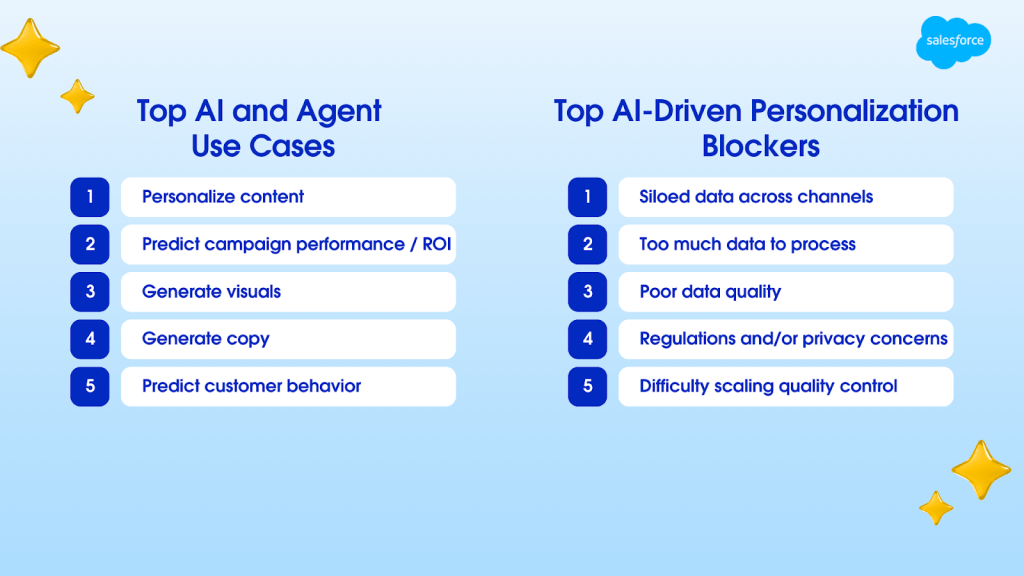
The trend in AI marketing is less about replacing teams and more about how quickly teams can integrate AI into daily operations.
Right now, brands use AI for research, audience segmentation, personalization, creative testing, reporting, and machine learning-assisted optimization.
The best programs pair generative AI with clear editorial review, first-party data, and a defined measurement framework. AI usage is highest when it removes repetitive work without weakening human creativity.
Here is how companies are applying AI tools right now:
- Content teams use AI to brief, outline, edit, localize, and repurpose campaigns while keeping human subject-matter review in the loop. At Brenton Way, we measure the output of AI-supported content work against a simple standard: does this help the reader make a better decision?
- Paid media teams use AI for bidding, predictive audiences, creative variation, and performance diagnostics, but still need human strategy for positioning and offer-market fit. Brenton Way's IcarusX Flight system uses approximately 10% of a client's media budget to test creative variations, generating variations from the best-performing assets.
- SEO and AEO teams integrate AI into research, schema planning, answer-engine optimization, and entity coverage so brands can appear in both traditional search results and AI-generated responses. Brenton Way's AEO system starts with a live visibility audit showing exactly where a brand appears across ChatGPT, Perplexity, Gemini, and Google AI Overviews before any content is produced.
- Revenue teams use AI to connect campaign data, customer behavior signals, and sales workflows, which improves efficiency without turning brand voice into generic automation.
Artificial Intelligence Marketing Spend & Budgets Statistics
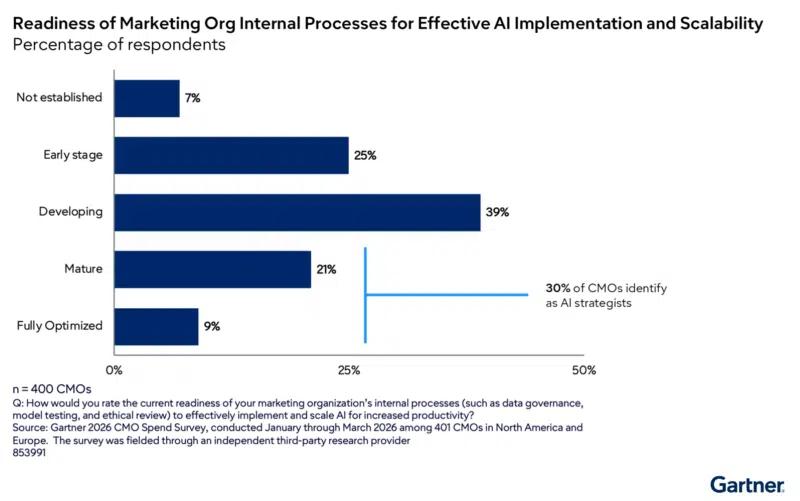
- CMOs allocate an average of 15.3% of their marketing budgets to AI initiatives. The most AI-ready organizations allocate 21.3%. (Source: Gartner CMO Spend Survey, 401 senior marketers, Jan to Mar 2026)
- Only 30% of CMOs report mature or fully developed AI readiness, even as 70% call becoming an AI leader a critical goal for 2026. (Source: Gartner)
- Global advertising spend is forecast to surpass $1 trillion for the first time in 2026, growing 5.1% year over year against approximately 3.1% projected GDP growth. (Source: Dentsu Global Ad Spend Forecast, Dec 2025)
- Digital advertising is projected to grow 6.7% in 2026 to 68.7% of total ad investment, with programmatic accounting for more than four-fifths of digital spend. (Source: Dentsu)
NOTE: Having AI tools is not AI readiness. AI readiness means your team can act on AI-generated signals faster than your competitors can, and that the signals connect to revenue decisions rather than campaign metrics alone.
Generative AI Usage for Content & Creative Statistics
Creators and creative teams have adopted generative AI almost universally, largely because content demand has outrun human capacity.
- 86% of content creators globally now actively use creative generative AI. Top uses are editing and enhancement (55%), generating new assets (52%), and ideation (48%). (Source: Adobe and Harris Poll, 2025 Creators' Toolkit, 16,000+ creators across 8 countries)
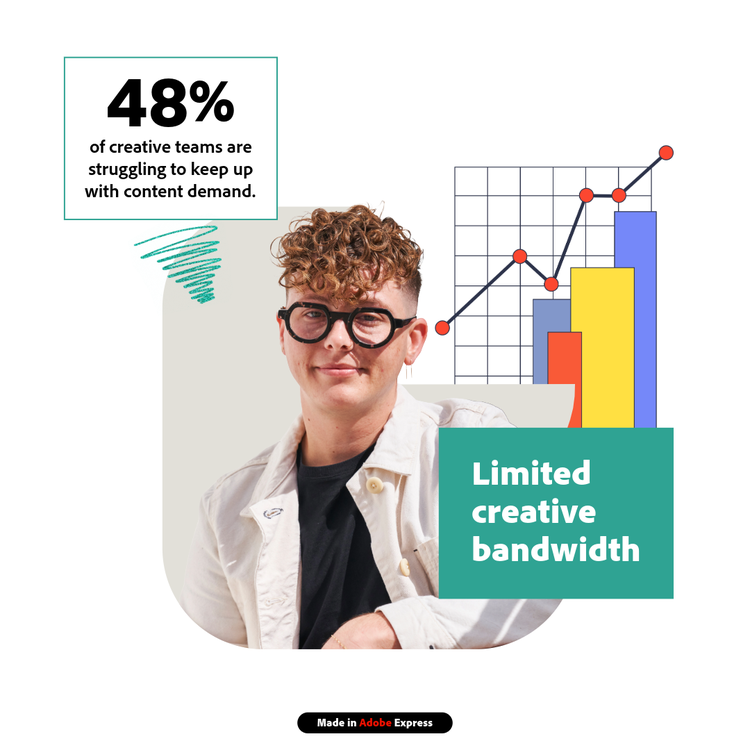
- 99% of creative professionals report using generative AI in some capacity, and content demand has doubled for 96% of marketers. Meanwhile, 48% of creative teams say they cannot keep pace. (Source: Adobe and Advanis, Oct 2025)
- 88% of creative professionals say generative AI helps them produce content faster, with 68% reporting at least a 20% drop in production time. (Source: Adobe and Advanis, self-reported)
- 55% of marketers use AI for content creation, the most popular AI use case in content marketing, up 12% year over year. AI is also used by 56% for short-form video and 53% for image generation. (Source: HubSpot 2025 State of AI)
NOTE: Adobe's 86% figure includes emerging and semi-professional creators, while the 99% figure includes full-time creative professionals. These are different survey populations, not the same group. And these are vendor surveys from companies that sell creative AI, so read them as adoption signals rather than audited facts.
AI Technologies in Advertising & PPC Statistics
In paid media, AI has shifted from a targeting engine to a creative engine. This means advertisers now use generative AI to build ads themselves, though full AI integration across the campaign lifecycle is still in its early stages.
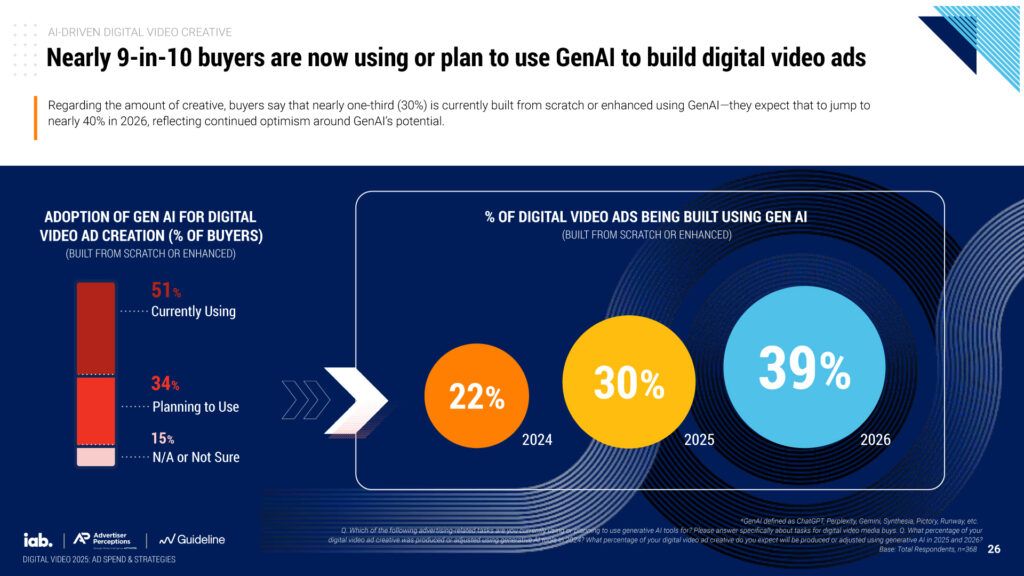
- 86% of video ad buyers are using or planning to use generative AI to build video ad creative, and 50% are already doing it. (Source: IAB 2025 Digital Video Ad Spend and Strategy, July 2025)
- Only 30% of agencies, brands, and publishers have fully integrated AI across the media campaign lifecycle. But half of those not yet integrated expect to be by the end of 2026. (Source: IAB State of Data 2025, 500+ buy- and sell-side experts)
The 70% of organizations that have not yet integrated AI across their campaign lifecycle are not behind because they lack tools. They are behind because they haven't connected AI output to a decision-making process.
Our IcarusX Atlas technology solves this problem: it is a living memory of brand strategy, audience insights, creative learnings, competitor notes, and performance history that connects directly to Meta Ads, Google Ads, GA4, and Shopify. The longer the engagement runs, the more the system knows, and the harder it becomes for a competitor to replicate.
AI Search & Answer Engine Optimization (AEO) Statistics
Leveraging AI in AEO has the biggest long-term implications for every brand's organic visibility.
For a deeper look at what this means strategically, see our guide to AEO statistics and trends and the rise of AGI SEO.
- 88% of marketers have already begun optimizing for AI-generated responses, and 85% say AI is reshaping their SEO strategy. (Source: Salesforce 10th State of Marketing)
- 18% of Google searches generated an AI summary. When one appeared, users clicked a traditional search result in just 8% of visits, versus 15% without a summary. Users clicked a link inside the summary itself only 1% of the time. (Source: Pew Research Center, 68,879 searches, March 2025; measured as behavioral data, not a survey)
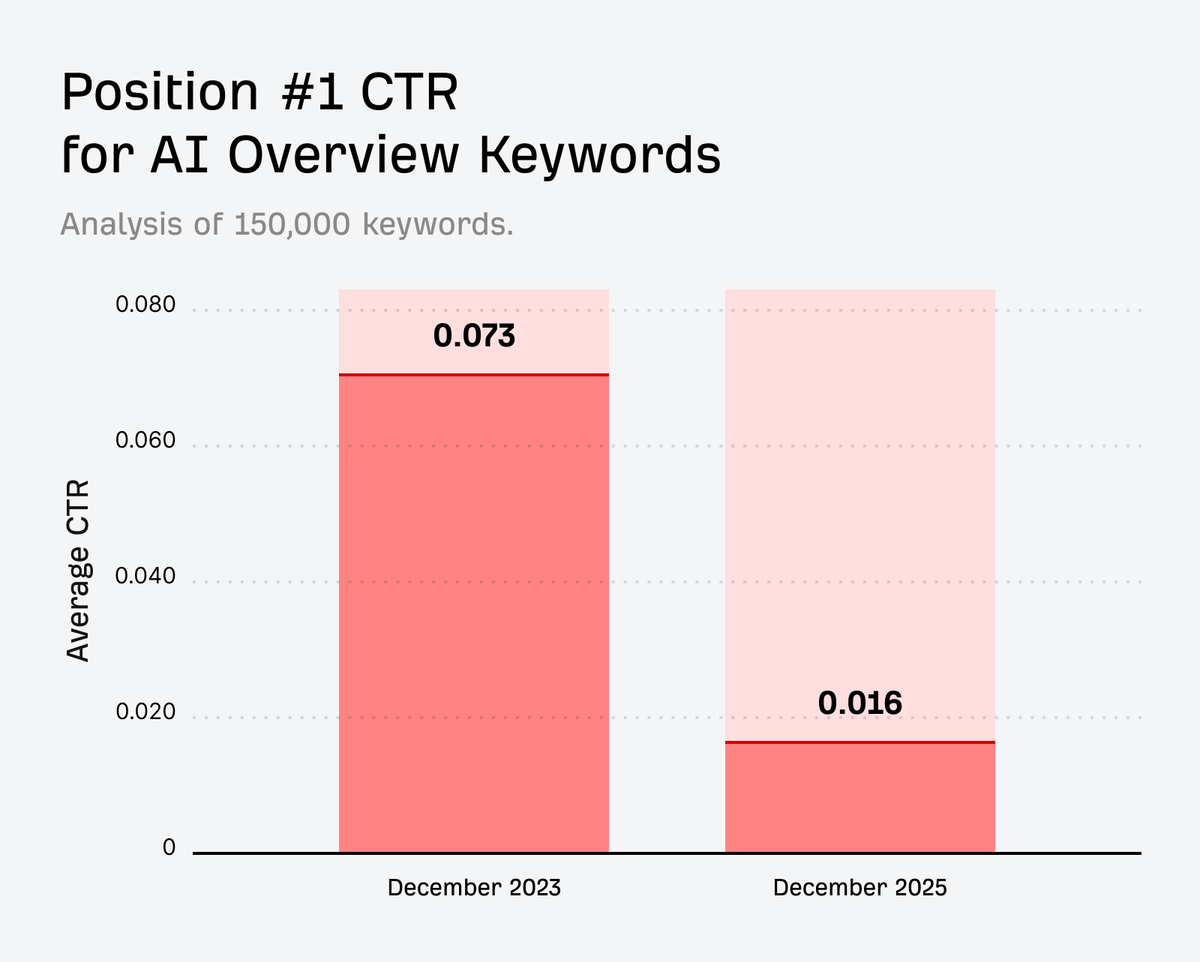
- The presence of a Google AI Overview correlates with a 58% lower click-through rate for the top-ranking organic result. Position-one CTR for AI Overview keywords fell from 0.073 to 0.016 between December 2023 and December 2025. (Source: Ahrefs, 300,000 keywords)
- The share of ChatGPT answers that include citations rose from 0.6% to 2.8% between January and August 2025. Total AI referral visits to websites grew more than 3x between September 2024 and September 2025. (Source: Similarweb)
These statistics imply that ranking is no longer enough for marketing professionals and teams. If an AI Overview answers the question before a user clicks, your content needs to be the source AI trusts, not just the result that ranks below it. That is what answer engine optimization is designed to do.
AI in Ecommerce & Personalization Statistics
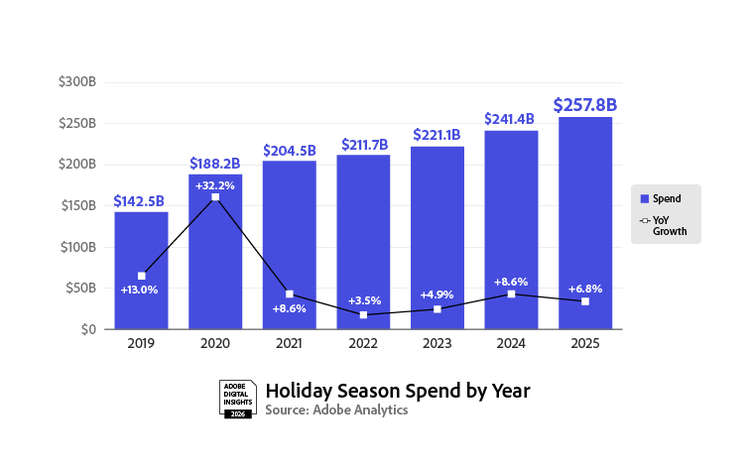
Nowhere is AI's commercial impact easier to quantify than in retail, where AI now drives discovery, recommendation, and a fast-growing share of actual purchases. For category-specific data, see our ecommerce statistics and Shopify statistics.
- AI and AI agents drove 20% of online retail sales during the 2025 holiday season (Nov 1–Dec 31), generating $262 billion in revenue through personalized recommendations and engagement (Source: Salesforce 2025 Holiday Shopping Data; note that this is 20% of online retail, not all-channel)
- Shoppers referred from AI-powered search (ChatGPT, Perplexity) converted 9× more often than those from social-media referrals (Source: Salesforce)
- Traffic to U.S. retail sites from generative AI tools increased to +693% year over year in the 2025 holiday season, with Cyber Monday increasing up to +670% (Source: Adobe Analytics, January 2026)
- 39% of U.S. consumers have already used generative AI for online shopping, and 53% planned to use it in 2025 (Source: Adobe consumer survey; 5,000+ consumers)
- About 50% of consumers are cautious about letting AI agents complete purchases autonomously; Between 30–45% already use gen AI for product research; and 17% of online shoppers say they'll start holiday shopping on an AI platform, rising to 52% of Millennials (Source: Bain & Company, November 2025)
A visitor who arrives after an AI system recommended your brand is not browsing. They are already evaluating. This changes what the landing page, the offer, and the follow-up sequence need to do. Brenton Way's conversion optimization work for ecommerce and B2B clients is built for this kind of high-intent traffic: less friction, faster proof, a clearer next step.
AI Marketing ROI & Performance Statistics
So, does artificial intelligence in marketing pay off?
Well, among the marketers who have invested, the self-reported answer is overwhelmingly yes, with the usual caveat that the people who invested are inclined to say it worked.

The statistics show that:
- 75% of senior marketers whose organizations invested in AI report positive ROI, and only 4% report negative ROI (Source: HubSpot AI Trends for Marketers)
- 65% of senior marketers plan to increase their investment in AI and automation tools (Source: HubSpot)
Statistics on Consumer Sentiment Toward AI
AI adoption is growing quickly, but consumer trust is not growing at the same pace. This gap is something every marketer using AI needs to consider, not ignore.
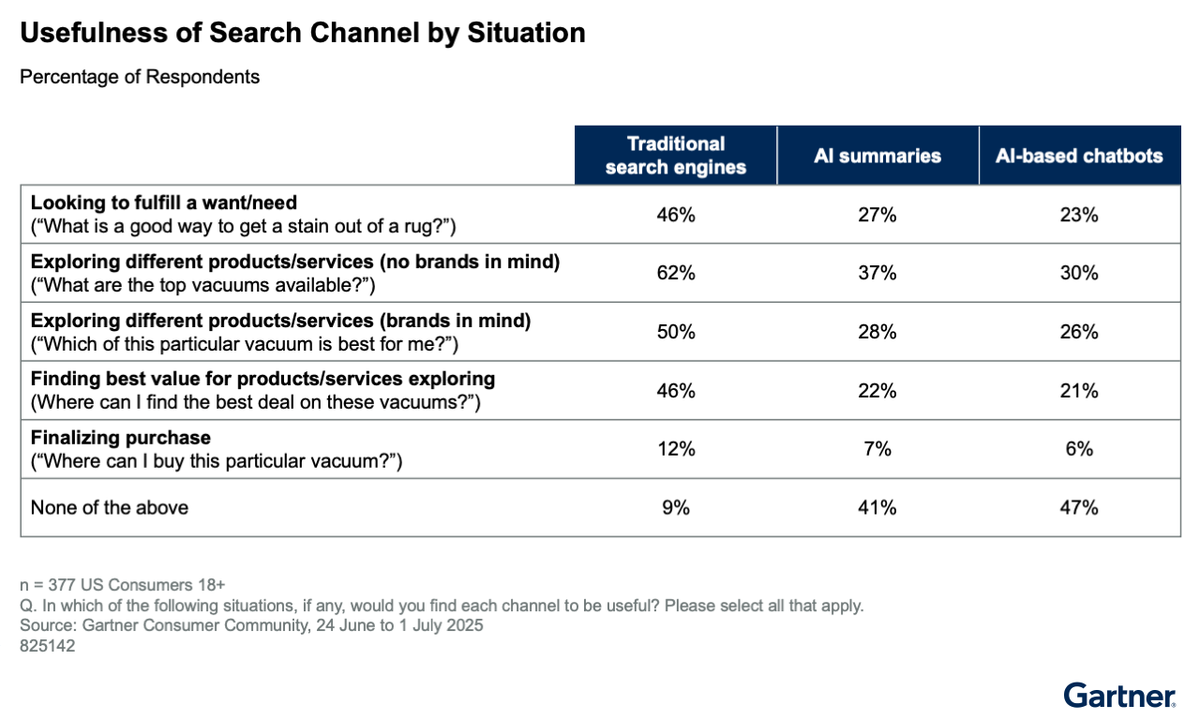
- 53% of U.S. consumers distrust or lack confidence in the reliability and impartiality of AI search results and summaries (Source: Gartner; June–July 2025)
- 61% of consumers wish they had an option to toggle AI summaries on or off (Source: Gartner)
AI Governance, Risk & Responsible AI
People are using AI, but they do not fully trust it yet. Data from the largest global study on this topic makes that very clear.
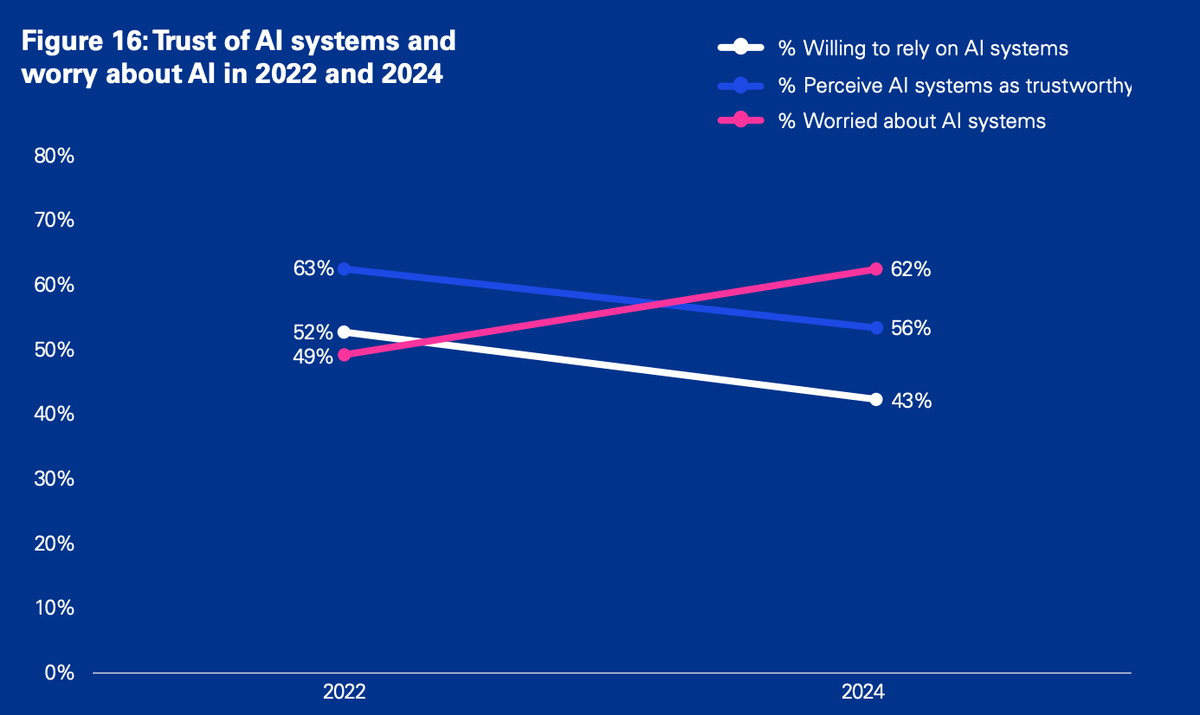
- Only 46% of people globally are willing to trust AI systems; 70% believe AI regulation is needed, yet just 43% think existing laws are adequate (Source: KPMG & University of Melbourne, Trust, Attitudes and Use of AI: A Global Study 2025; 48,000+ people across 47 countries).
For marketers, this means one thing: be transparent. Transparency is your biggest competitive advantage.
As AI creates more content and more customers find brands through AI search, brands that are upfront about how they use AI will build more trust than those that aren't.
Brenton Way's position on AI in marketing is published and clear: our technology supports our strategists; it does not replace their judgment. Every campaign hypothesis, every creative brief, every AEO audit starts with a human decision.
Our AI marketing systems are designed to make that decision faster and better-informed, not to remove it from the process.
The Brenton Way Take: What These Numbers Mean Now
The brands staying relevant are the roughly 30% that are AI-ready, not just AI-curious. If your team is using AI but not measuring its impact, you are in the majority, and you are at a disadvantage.
With the top organic result losing more than half its clicks where AI Overviews appear, optimizing for answer engines is now as important as classic SEO.
Additionally, consumers are adopting AI shopping tools while simultaneously distrusting AI answers.
If you are rethinking your AI and AI-search strategy for 2026, get in touch with Brenton Way. We help brands build the visibility and trust that compound in an AI-driven search environment.
Frequently Asked Questions (FAQs)
What percentage of marketers use AI in 2026?
As of the current year, 86.4% of marketing teams use AI in at least a few areas, and only 1.7% don't use it and don't plan to, according to HubSpot's current-year State of Marketing report. Salesforce separately found that 75% of marketers have adopted AI.
How much of marketing budgets goes to AI?
CMOs allocate an average of 15.3% of their marketing budgets to AI initiatives, rising to 21.3% at the most AI-ready organizations, per Gartner's current-year CMO Spend Survey. Still, only 30% of CMOs report mature AI readiness.
How is AI search affecting website traffic?
AI summaries are reducing clicks. Pew Research found that when a Google AI summary appears, users click a traditional search result in only 8% of visits versus 15% without one. Ahrefs found the top organic result sees a 58% lower click-through rate when an AI Overview is present.
What is Answer Engine Optimization (AEO)?
AEO is the practice of optimizing content to be surfaced and cited by AI answer engines such as ChatGPT, Perplexity, and Google AI Overviews, rather than only ranking in traditional search results. As of 2025, 88% of marketers report they have already begun optimizing for AI-generated responses.
Does AI marketing deliver positive ROI?
Among marketing leaders whose organizations invested in AI, 75% report positive ROI and only 4% report negative ROI, according to HubSpot. Note this reflects organizations that already invested, so it carries some optimism bias.
How much of ecommerce is driven by AI?
AI and AI agents drove 20% of online retail sales during the 2025 holiday season, generating $262 billion in revenue, per Salesforce. Shoppers referred from AI search converted 9 times more often than those from social media.
Do consumers trust AI?
Trust is limited. Only 46% of people globally are willing to trust AI systems (KPMG/University of Melbourne, 2025), and 53% of U.S. consumers distrust AI search results (Gartner, 2025). 70% globally believe AI regulation is needed.
Are these AI marketing statistics from reliable sources?
Yes. Every statistic on this page is sourced to its original publisher, including Gartner, Pew Research, Salesforce, HubSpot, Adobe, IAB, Dentsu, Bain, Similarweb, Ahrefs, and KPMG, with the publication year noted. We exclude unverified figures that circulate without primary attribution.
Tags
Let's Grow Your Brand With Us
Book a free consultation and get a custom growth strategy tailored to your business.
Book Free ConsultationGet marketing insights in your inbox
Join our newsletter for the latest digital marketing tips and strategies.
By subscribing, you agree to our Privacy policy .

About the author
Jonathan SaeidianHead of Strategy at Brenton Way
Jonathan Saeidian is the founder of Brenton Way, Bridge, and Growth Virality, where he builds measurable growth marketing systems for startups, scaleups, and enterprise teams.


