TikTok Marketing Statistics: 2026 Data, Trends & Strategy Insights

TL;DR
Updated TikTok marketing statistics for 2026 with sourced U.S. ad reach, audience demographics, global attention benchmarks, TikTok Shop commerce data, social search behavior, creator pricing trends, charts, and strategy takeaways.

Ask AI about this
Get an AI-powered summary of this article
Table of Contents
TikTok marketing in 2026 is not a simple reach story. The platform is a large U.S. media channel, a high-attention mobile app, a product discovery engine, a creator marketplace, and an increasingly serious social commerce layer. The strategic question for brands is no longer whether TikTok is big. It is whether the brand has enough social media marketing strategy, creative testing volume, creator fit, measurement discipline, and commerce readiness to use the channel well.
This 2026 guide uses current platform, survey, commerce, and app-usage data from Pew Research Center, DataReportal Digital 2026, DataReportal United States 2026, DataReportal Mid-Year 2026, the U.S. Supreme Court TikTok v. Garland opinion, AP, Business Insider, and Axios. The numbers below should be used as planning benchmarks, not as a substitute for live TikTok Ads Manager reach estimates by country, age, placement, and audience.
TikTok Marketing Statistics at a Glance
- TikTok remains a mass-reach U.S. platform, with more than 170 million U.S. users cited in the Supreme Court record.
- DataReportal reports that TikTok had 153 million U.S. users aged 18 and above in late 2025, equal to 55.7% of U.S. adults.
- TikTok reported 2.21 billion global adult ad-reachable users excluding India, but DataReportal warns that reported ad reach and third-party usage data do not always move together.
- Among U.S. adults, TikTok adoption has held near one-third of the population since 2023, according to Pew Research Center.
- TikTok is still age-skewed: 63% of U.S. adults ages 18-29 use it, compared with 12% of adults 65 and older.
- Globally, DataReportal reports that 36% of online adults use TikTok monthly when China is excluded from the TikTok figure.
- TikTok is a high-attention app: DataReportal/Similarweb reports 1 hour and 37 minutes per day for the typical Android user.
- TikTok Shop has moved from test channel to commerce channel, crossing $500 million in U.S. GMV during the 2025 Black Friday to Cyber Monday period; ecommerce teams should compare this with broader Shopify statistics and marketplace benchmarks.
- Among 18- to 24-year-olds, 21% start information searches on TikTok, compared with 46% who start on Google, according to YPulse data reported by Axios.
- TikTok micro-creators with 15,000 to 50,000 followers saw average brand fees rise 125% year over year in Q1 2026, making creator pricing a useful companion to broader influencer marketing statistics.
1. TikTok still reaches more than 170 million U.S. users
The most durable U.S. reach number remains 170 million-plus users. The Supreme Court opinion in TikTok Inc. v. Garland describes TikTok as having more than 170 million U.S. users, a useful baseline because it appears in an official legal record rather than a recycled marketing roundup.
For marketers, that means TikTok is large enough to support national awareness, product launches, creator programs, social search, retail activations, and performance campaigns. But the number should not be used as campaign reach. TikTok Ads Manager should still be the source of truth for paid media planning after filters for country, age, interests, placements, language, and exclusions.
2. TikTok had 153 million U.S. adult ad-reachable users in late 2025
DataReportal’s Digital 2026 United States report reports that TikTok had 153 million U.S. users aged 18 and above in late 2025. The same report says TikTok ads reached 55.7% of all U.S. adults and 47.3% of the local internet user base.
That is the cleaner number to use for media planning because it is tied to TikTok advertising resources and adult ad reach. It is narrower than the 170 million-plus all-user figure, but it is more actionable for teams planning paid reach, creative volume, and TikTok ads strategy.
| Metric | Users in millions |
|---|---|
| U.S. adult ad audience | 153M |
| YoY audience gain | 15.2M |
| Jul-Oct 2025 gain | 7.05M |
3. TikTok usage among U.S. adults is stable, not exploding
The 2026 planning story is maturity. Pew Research Center found that 37% of U.S. adults said they use TikTok in 2025, up from 33% in 2023 and 2024. The trend points to sustained growth, while the mode change beginning in 2023 means pre-2023 comparisons should still be treated carefully.
| Survey year | Share of U.S. adults who use TikTok |
|---|---|
| 2021 | 21% |
| 2023 | 33% |
| 2024 | 33% |
| 2025 | 37% |
This changes how brands should evaluate TikTok. The platform is less of a "new channel bet" and more of a channel-management problem: creative velocity, creator sourcing, paid amplification, comments, social search, and conversion measurement need operating owners. For broader channel context, compare this with our Facebook marketing statistics and X/Twitter marketing statistics.
4. TikTok remains strongest with younger adults
TikTok is not only a Gen Z app anymore, but age still matters. Pew reports that 63% of U.S. adults ages 18-29 use TikTok, compared with 44% of adults 30-49, 30% of adults 50-64, and 12% of adults 65 and older.
| Share using TikTok | Age group |
|---|---|
| 18-29 | 63% |
| 30-49 | 44% |
| 50-64 | 30% |
| 65+ | 12% |
The strategic implication is simple: TikTok can reach older buyers, but the platform is still most efficient when the target audience includes younger adults, younger parents, early-career professionals, students, creators, or culture-sensitive shoppers. That makes TikTok especially relevant for teams tracking Gen Z marketing trends.
5. TikTok over-indexes with women, Black adults, Hispanic adults, and lower-income households
Pew reports that 42% of U.S. women use TikTok compared with 30% of men. The same survey reports usage at 53% among Black adults and 57% among Hispanic adults, compared with 28% among White adults and 31% among Asian adults. Usage is also higher in households under $70,000 than in households over $100,000, which is why TikTok often shows up in beauty marketing, CPG marketing, and value-led retail strategies.
For beauty and personal-care teams specifically, TikTok audience fit should connect back to the broader beauty advertising playbook and current beauty marketing trends, because TikTok often shapes category demand before shoppers move to Google, Amazon, Sephora, Ulta, or brand-owned sites.
TikTok U.S. adult audience skews, 2025
| Audience segment | TikTok usage | Marketing implication |
|---|---|---|
| Women | 42% | Beauty, wellness, fashion, home, lifestyle, and creator-led product education can be strong fits. |
| Men | 30% | Performance varies more by niche, creator fit, and interest graph than broad gender targeting. |
| Black adults | 53% | Culture-led creative and community trust matter; avoid generic repurposed vertical video. |
| Hispanic adults | 57% | Bilingual, creator, local, beauty, food, entertainment, and retail strategies can overperform. |
| Household income under $30K | 42% | Promos, value framing, and creator proof can matter more than premium brand polish. |
| Household income $100K+ | 30% | Luxury and premium brands can still win, but need tighter audience and creator selection. |
6. TikTok is the sixth most-used social platform among global online adults
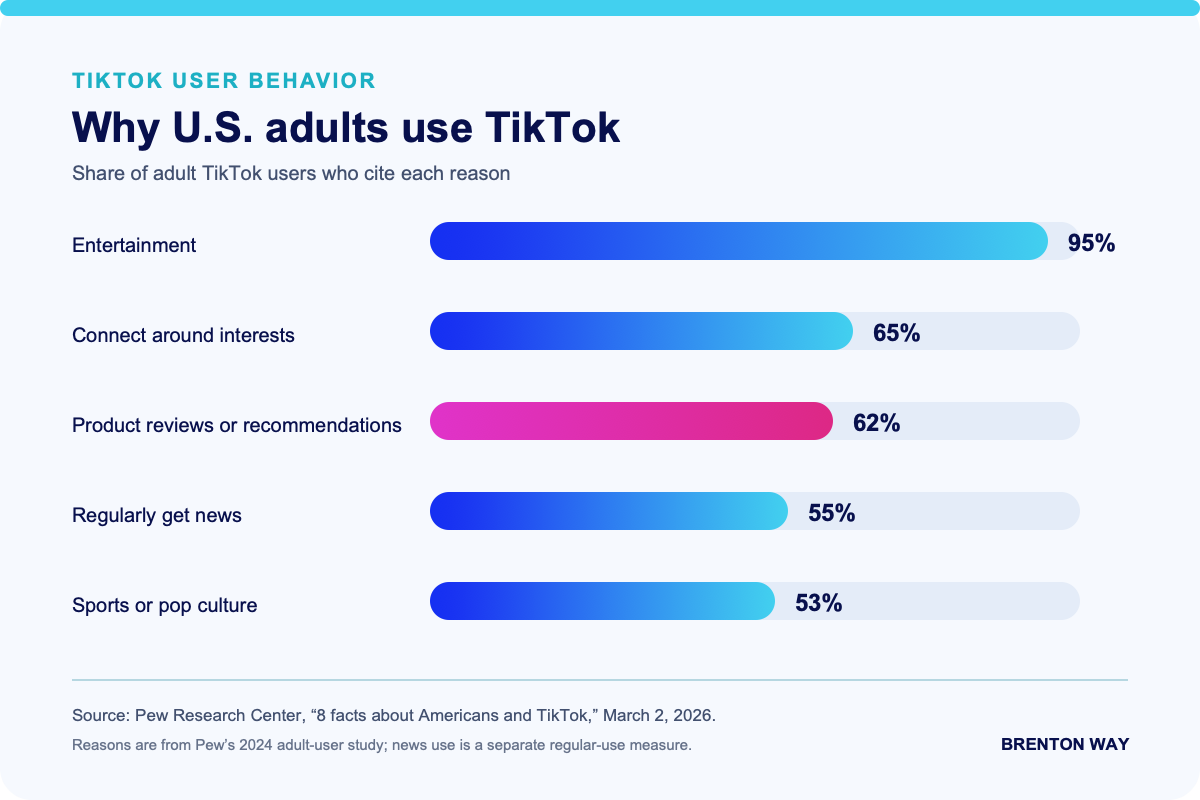
DataReportal reports that 36% of global online adults use TikTok each month, excluding China because TikTok survey responses in China map to Douyin, a separate ByteDance platform. That puts TikTok behind Facebook, YouTube, Instagram, WhatsApp, and Messenger in that global survey ranking, but still ahead of many large social platforms. Read the Digital 2026 report.
For international brands, this is a reminder to avoid global-average planning. TikTok may be a core channel in one market and a secondary creative testing channel in another. Country-level reach and CPMs should decide budget allocation, especially for ecommerce marketing teams that need market-by-market revenue forecasts.
7. TikTok reports 2.21 billion adult ad-reachable users globally, but usage data is mixed
DataReportal’s Digital 2026 Mid-Year Global Update reports that TikTok planning tools showed 2.21 billion users aged 18 and above in global ad reach, excluding India. The report also notes that this reported reach was more than 50% higher than Instagram’s comparable adult ad reach after removing India.
That sounds like a simple win for TikTok, but it needs context. DataReportal also says GWI research showed TikTok adoption was relatively stable over the prior two years, while Similarweb data indicated active use of TikTok mobile apps fell roughly 10% between September 2025 and February 2026. The practical takeaway: use TikTok ad reach for media buying inputs, but validate strategy against third-party usage, category fit, and your own data-driven marketing strategy.
TikTok reach vs. usage signals
| Signal | Figure | How to use it |
|---|---|---|
| Reported global adult ad reach excluding India | 2.21B | Useful for platform scale and paid-media planning, but not the same as monthly active users. |
| TikTok vs. Instagram comparable adult ad reach | 50%+ higher | Shows TikTok ad inventory scale after removing India from Instagram comparisons. |
| Similarweb active mobile-app use trend | Roughly -10% | A caution signal: reported ad reach can rise even when third-party usage trends soften. |
| Countries where reported adult reach exceeds adult population | 35 | A reminder to sanity-check platform reach estimates before building forecasts. |
8. TikTok wins on attention, not just reach
DataReportal, citing Similarweb App Intelligence, reports that the typical TikTok Android app user spends 1 hour and 37 minutes per day on the app. That is longer than Instagram, Facebook, and WhatsApp in the same ranking. DataReportal also reports that the typical TikTok Android user opens the app about 10 times per day.
| Platform | Minutes per day |
|---|---|
| TikTok | 97 min |
| 73 min | |
| 67 min | |
| 59 min |
That attention profile is why TikTok can shape demand before branded search, Amazon search, retail visits, or Google clicks happen. The platform often creates the question before another channel captures the answer, which is why TikTok creative should be coordinated with content marketing and search-intent content.
9. TikTok Shop is now a serious U.S. social commerce test
TikTok Shop launched fully in the U.S. in September 2023 with a Shop Tab, affiliate videos, and Fulfilled by TikTok logistics, according to AP. At launch, AP reported more than 200,000 registered sellers and more than 100,000 creators in the affiliate program.
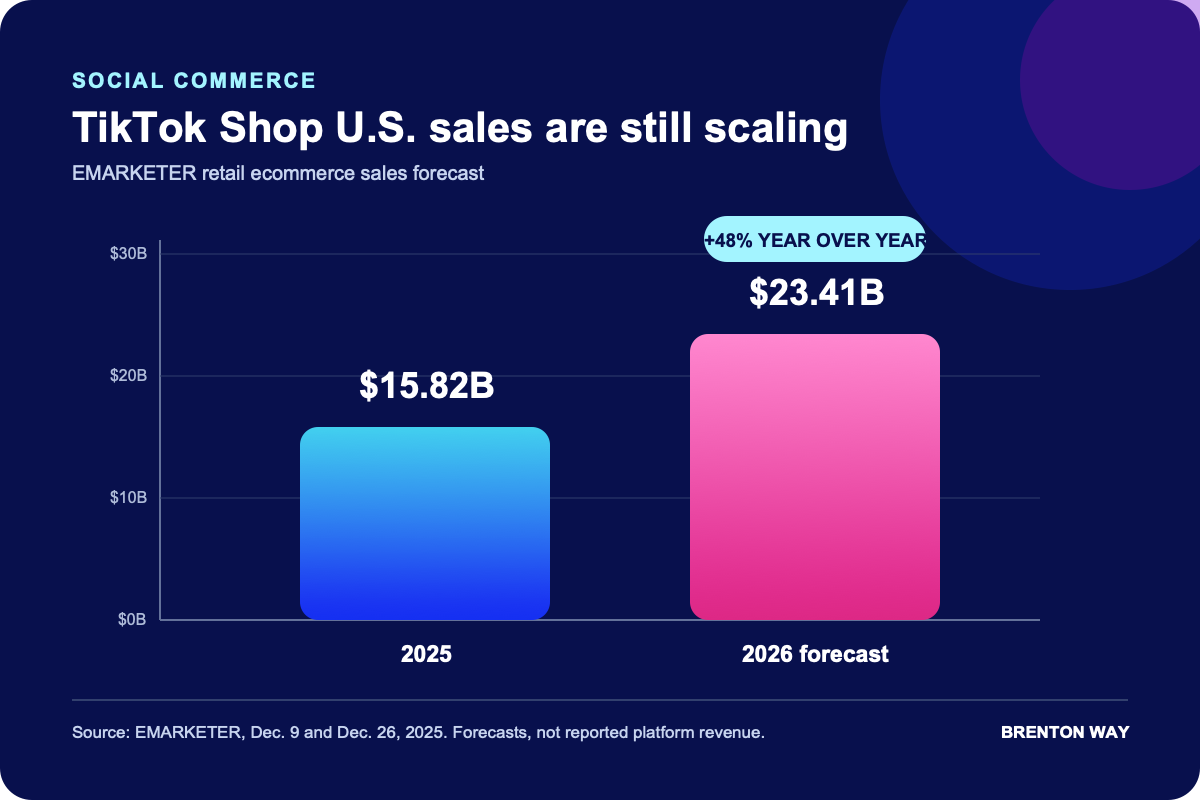
By the 2025 holiday season, Business Insider reported that TikTok Shop crossed $500 million in U.S. GMV during the Black Friday to Cyber Monday period, based on a company spokesperson. EMARKETER estimated TikTok Shop would cross $15.8 billion in U.S. sales in 2025, and expected U.S. social-commerce spending to pass $100 billion in 2026. For ecommerce benchmark context, compare this with our Shopify statistics and ecommerce marketing statistics.
TikTok Shop commerce milestones
| Metric | Figure | Why it matters |
|---|---|---|
| Registered sellers at U.S. launch | 200,000+ | TikTok Shop started with enough merchant depth to support marketplace discovery. |
| Creators in affiliate program at U.S. launch | 100,000+ | Affiliate creator content is central to product discovery and conversion. |
| U.S. BFCM GMV, 2025 | $500M+ | TikTok Shop is now relevant for holiday, launch, and creator-led ecommerce planning. |
| EMARKETER U.S. TikTok Shop sales estimate, 2025 | $15.8B | Brands should treat Shop as a possible revenue channel, not only a media add-on. |
| Projected U.S. social-commerce spend, 2026 | $100B+ | Creator affiliate, Shop, and social product discovery are converging. |
10. TikTok Ads are moving beyond direct response
In March 2026, Axios reported that TikTok introduced ad products aimed at higher-impact brand storytelling, including sequential storytelling and top-reach formats. That matters because TikTok is trying to serve both performance advertisers and larger brand media budgets.
For Brenton Way clients, the practical takeaway is that TikTok plans should not force every dollar into last-click response. The channel can support awareness, creator proof, retargeting pools, product education, and direct commerce. The campaign structure should match the job, and winning creative usually borrows from proven TikTok advertising campaigns and platform-native ad creative best practices.
11. TikTok is a social search and demand-creation channel
TikTok content often shapes what people search next. A viewer may discover a product, ingredient, procedure, local business, or creator recommendation on TikTok before searching Google, Amazon, Reddit, YouTube, or the brand site. That makes TikTok important even when last-click attribution undercounts it.
YPulse data reported by Axios found that 46% of 18- to 24-year-olds start information searches on Google, compared with 21% who start on TikTok and 5% who start on YouTube. For brands, that means TikTok can compete for early-stage information demand, especially when users want relatable answers, examples, and comments from other people.
| Share of 18- to 24-year-olds | Starting platform |
|---|---|
| 46% | |
| TikTok | 21% |
| YouTube | 5% |
The strongest TikTok SEO content is built around intent, not just trends: best, review, before and after, what I wish I knew, cost, mistakes, routine, comparison, how to use, alternatives, and worth it. These formats match how users ask questions inside social search and should feed the same editorial system that supports content marketing.
12. TikTok creator economics favor micro-creator portfolios
Business Insider reported Upfluence data showing that TikTok micro-creators with 15,000 to 50,000 followers saw average partnership fees rise 125% year over year in Q1 2026. In the same period, macro creator fees fell 29% and mega creator fees fell 18%. Read the creator pricing analysis.
That supports a practical creator strategy: build a portfolio of niche creators with high trust and category fit, then amplify winning posts with paid media. Brands should not assume a larger follower count creates better economics. On TikTok, comment quality, creator-audience match, hook strength, and product proof often matter more than vanity reach. Use this alongside our influencer marketing services and influencer marketing statistics.
This also fits the broader paid-amplification trend. Business Insider reported EMARKETER forecasts that U.S. spending on creator fees and paid boosting will be roughly even at $14.2 billion next year, and that social amplification spend excluding YouTube will reach $16.1 billion in 2028, surpassing sponsored-content production spend.
TikTok creator fee movement by creator tier
| Creator tier | Follower range | Q1 2026 fee movement |
|---|---|---|
| Micro, higher end | 15K-50K followers | +125% YoY |
| Macro | 150K-500K followers | -29% YoY |
| Mega | 500K+ followers | -18% YoY |
13. What brands should measure on TikTok in 2026
TikTok measurement should connect creative, search, commerce, and CRM signals. Views alone are not enough, and last-click ROAS alone will miss much of the platform value.
- Creative quality: thumb-stop rate, average watch time, completion rate, rewatches, saves, comments, and share rate.
- Search lift: branded search, product search, Google Trends movement, Amazon search, retail search, and on-site search queries.
- Commerce: TikTok Shop GMV, affiliate sales, product clicks, creator code usage, SKU-level lift, and repeat purchase behavior.
- Paid media: Spark Ads performance, CAC, MER, view-through windows, creative fatigue, and holdout or geo-test lift.
- CRM: email/SMS capture, lead quality, booked calls, consultation starts, and cohort revenue.
TikTok Marketing Strategy Recommendations for 2026
- Build a 90-day creative testing system before scaling spend. TikTok rewards creative volume and audience-learning loops. Use Brenton Way’s ad creative best-practices guide when translating tests into paid media briefs.
- Treat creators as media, research, and production partners. The right creator can supply language, trust, and distribution at once.
- Use Spark Ads to amplify organic proof before producing expensive net-new ads, especially when an organic post behaves like the successful examples in these TikTok advertising campaigns.
- Create social-search content around buyer questions, not only trend participation.
- Evaluate TikTok Shop if the product has visual proof, creator fit, impulse potential, repeat purchase logic, or affiliate economics. For benchmark context, use broader ecommerce marketing statistics before setting revenue expectations.
- Measure TikTok against assisted demand, not only same-session conversion.
Sources and Methodology
Primary and research sources for this 2026 update include the U.S. Supreme Court TikTok v. Garland opinion, Pew Research Center, DataReportal 2026 reports, AP, Business Insider, and Axios.
Methodology note: platform audience numbers, ad reach, TikTok Shop GMV, and creator commerce estimates can change quickly and may use different methodologies. For media planning, validate final reach, CPM, CPA, and TikTok Shop sales forecasts inside TikTok Ads Manager, TikTok Seller Center, GA4, CRM, and retail marketplace analytics.
Frequently Asked Questions
The U.S. Supreme Court opinion in TikTok v. Garland describes TikTok as having more than 170 million U.S. users. For ad planning, DataReportal reports 153 million U.S. TikTok users aged 18 and above in late 2025, equal to 55.7% of U.S. adults.
Pew Research Center found that 37% of U.S. adults said they use TikTok in 2025. Usage is much higher among younger adults, reaching 63% for adults ages 18-29.
DataReportal Digital 2026, citing Similarweb App Intelligence, reports that the typical TikTok Android app user spends 1 hour and 37 minutes per day on the app.
Yes, for the right category. Business Insider reported that TikTok Shop crossed $500 million in U.S. GMV during the 2025 Black Friday to Cyber Monday period. Product fit, creator economics, fulfillment, and margin still determine whether it makes sense for a specific brand.
Yes, especially for younger users and discovery-led categories. YPulse data reported by Axios found that 21% of 18- to 24-year-olds start information searches on TikTok, compared with 46% who start on Google.
Brands should test micro-creators alongside larger creators. Business Insider reported Upfluence data showing that TikTok creators with 15,000 to 50,000 followers saw average partnership fees rise 125% year over year in Q1 2026, while macro and mega creator fees declined.
Brands should measure watch time, saves, shares, comments, branded search lift, TikTok Shop sales, creator code usage, assisted conversions, CAC, MER, lead quality, and repeat purchase behavior. Views alone are not enough.
Tags
Let's Grow Your Brand With Us
Book a free consultation and get a custom growth strategy tailored to your business.
Book Free ConsultationGet marketing insights in your inbox
Join our newsletter for the latest digital marketing tips and strategies.
By subscribing, you agree to our Privacy policy .

About the author
Jonathan SaeidianHead of Strategy at Brenton Way
Jonathan Saeidian is the founder of Brenton Way, Bridge, and Growth Virality, where he builds measurable growth marketing systems for startups, scaleups, and enterprise teams.


