Cosmetics Advertising: Strategies, Examples & How to Run Cosmetic Product Ads

TL;DR
This guide covers how to approach a cosmetics advertising campaign from the product and audience, through the creative development, paid media, landing page, testing, and optimization.

Ask AI about this
Get an AI-powered summary of this article
Table of Contents
Cosmetics Advertising Strategies: A Step-by-Step Guide to Running Ads
A cosmetic product can look premium in a photograph and still struggle to sell through paid media. The problem is often not the product itself. The issue may be that the wrong shopper is seeing the ad, the wrong buying reason is being communicated, the wrong purchase is being requested too soon, or the shoppers are clicking on a page that can’t answer their questions.
In effective cosmetics advertising, the product defines the message, the buyer defines the angle, the platform defines the communication, and the landing page has to deliver on the purchase. Unlike other industries, cosmetics advertising is product-led rather than brand-led, and requires a different set of assumptions and considerations.
This guide covers how to approach a cosmetics advertising campaign from the product and audience, through the creative development, paid media, landing page, testing, and optimization.
What Is Cosmetics Advertising?
Cosmetics advertising refers to paid promotion that aims to drive awareness, consideration, traffic, and sales. It can take many forms, including search, Shopping ads, paid social, creator media, video advertising, retail media, and email marketing. The key difference compared to advertising for other products is the level of detail and specificity around the product. A general beauty advertising campaign may span an entire category, brand, service, or industry. Cosmetics advertising is product-led rather than brand-led, and should be built around buying reasons such as:
• What product are we advertising?
• What is the benefit of this formula, color, finish, texture, or presentation?
• Who is the likely buyer for this product?
• What proof do we have available?
• What should the buyer do next after seeing the ad?
This level of product specificity makes a cosmetics advertising campaign easier to build, test, and optimize.
Why Cosmetic Ads Fail Even When the Product Is Good
Many underperforming campaigns have a message problem rather than a traffic problem. A brand may advertise a serum with beautiful lifestyle photography, but the shopper is looking for reassurance that the serum will fit into their routine, feel pleasant on their skin, perform a certain action, come in the quantity they want, and represent value for money.
This is also relevant to makeup advertising examples. If a lipstick ad only shows the package, the shopper has to determine whether the product will look good on their skin, how it will feel to apply, how it will fit into their makeup routine, and whether the finish, fit, and color will suit their skin tone and type.
They may also want to compare it to similar products in the same category. Before increasing a budget, ask: What information is the ad not providing that the shopper needs to know?
How to Run a Cosmetics Advertising Campaign Step by Step
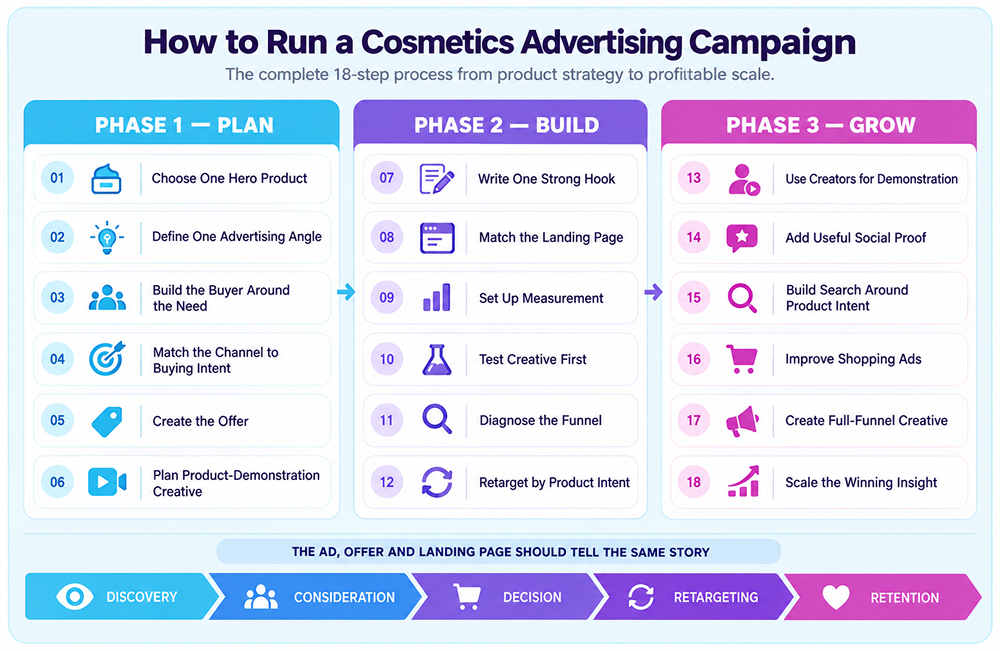
1. Start With One Product, Not the Entire Catalog
Pick a hero product or a highly related product group for the cosmetics advertising campaign. Advertising an entire catalog of products in one message waters down the creative and makes performance analysis challenging. A customer looking for a matte foundation should not have to interpret a general brand ad before finding the right product.
Select the product with a clear commercial reason to advertise. That may be a best-selling product, a new launch, a high-margin product, a product with positive reviews, or one where the brand has a point of difference. Then, define the conversion that this campaign should drive. For ecommerce, it will often be a purchase, but it may vary depending on the stage in the product lifecycle. Once a hero product has been selected, define:
- Hero product: the specific SKU, shade range, or family being advertised
- Primary outcome: purchase, qualified product traffic, new-customer acquisition, or another defined action
- Commercial constraint: target CPA, discount level, margin, or ROAS
- Proof available: reviews, demos, testing, ingredients, creator content, or other substantiation
2. Turn the Product Into a Single Advertising Angle
Rather than asking “What should the advertising look like?” start with “Why would someone buy this product over a competing product?” This is the advertising angle.
A single product can have multiple valid angles, but each ad should usually focus on one. Foundations can be built around buildable coverage, finish, shade range, or wear. Cleansers can be around formulation, texture, recommended use, or where it fits into a skincare routine. Fragrances can be built on scent, intended use, or occasion.
Once the angle has been defined, apply it consistently across the ad, headline, and supporting creative. The ad and landing page should tell the same story to reduce the distance between the click and purchase.
3. Build the Buyer Around the Product Need
Cosmetic audiences are rarely defined by age and gender alone, and increasingly, the most relevant segment to advertise to is the one that reflects the use case rather than the characteristics. Someone shopping for foundation to wear to the office will make a different decision than someone shopping for full coverage makeup for an event.
This means defining the audience based on use case, product knowledge, and decision factors rather than broad demographics. Search intent can indicate use case, but social advertising can also build it with creator demonstration.
- Use case: everyday makeup, event use, skincare routine, gifting, travel, or specific occasion
- Product knowledge: first-time buyer, category shopper, competitor-aware, or existing customer
- Decision factor: shade, finish, or formulation for makeup; ingredients, price, or formulation for skincare; scent, occasion, or format for fragrance
The same principles apply to objections, which will vary depending on the buyer type. First-time buyers may have questions about the fit or application, while existing customers may be sensitive to changes in formulation or pricing.
4. Choose the Channel Based on Buying Intent
Rather than launching campaigns on popular channels, choose the ones where the product is discovered and evaluated. Google Search is appropriate when people are actively looking for the product type or brand. A specific foundation, serum, or fragrance can usually be found faster in a search engine than on social media, and the intent to purchase is likely to be higher. Google Shopping can increase visibility of the product, image, and price before the click.
Meta platforms are useful when the product benefits from visual discovery and demonstration. Product demos, creator content, carousels, and customer reviews provide multiple entry points to communicate benefits. TikTok can be appropriate when the product requires demonstration or explanation, and it has specific formats for product sales such as Shop Ads and Web Conversions for beauty product brands.
The same applies to YouTube, which is increasingly used for product tutorials and comparisons rather than traditional advertising. A combination of high-intent search advertising and visual discovery channels is usually the most effective cosmetics advertising strategy, even if it takes time to build.
5. Build the Offer Before You Build the Ad
An ad creative can build desire, but it rarely provides a reason to buy. Define what the customer will receive and why it matters before writing the ad copy. Discounting is not the only option. Depending on commercial constraints and the product type, a cosmetic brand may advertise a bundle, free shipping threshold, gift with purchase, sample, introductory bundle, or launch offer.
The choice of offer depends on the margin, average order value, and purchase commitment for the product type. A premium serum may advertise a routine bundle, whereas a makeup product may advertise a shade discovery offer. A recurring purchase product may need to advertise replenishment or subscription rather than a general purchase.
Ensure that the offer is consistent between the ad and the landing page so that the customer does not have to infer it.
6. Create Cosmetic Ad Creative That Demonstrates the Product
Cosmetics are visual products, but that does not always mean that visual advertising is effective. A close-up shot of the product can indicate its appearance, but a product demonstration can address much more valuable information, such as what it feels like to use, how it performs its intended function, and whether it fits into the buyer’s routine.
- Makeup: Show how it is applied, its finish, how it looks on different skin tones, and how it moves and interacts with lighting
- Skincare: Demonstrate the feel, quantity, and placement in the skincare routine, the packaging and portability, and the intended purpose without making exaggerated claims
- Hair and body: Show how the product is applied, its feel and format, and the context in which it is used
- Fragrance: Focus on the scent, occasion, and experience rather than the visual appearance of the product
- Gift sets: Indicate what is included in the set, the combined value, and who it is intended for
A cosmetics advertising example creative set might include a product demonstration, a UGC-style review, a problem-product concept, an offer-led static ad, and a founder or expert explanation. The aim is not to create five similar ads, but to test five different reasons for the shopper to choose this product over a competing one.
7. Write the Ad Around One Strong Hook
Cosmetic ad copy becomes weak when it tries to sound impressive instead of useful. Replace generic claims such as 'elevate your beauty routine' with a specific reason to stop and pay attention.
A practical structure is: problem or desire → product → specific benefit → proof → offer → CTA.
For example, a foundation ad could open with: 'Want buildable coverage without a heavy-looking finish?' The next line can identify the product and explain the finish. The video can demonstrate the application. The landing page can then provide shade information, reviews, and the purchase option.
For paid social, write the first sentence for someone who has never heard of the brand. For search ads, align the copy more closely with the query and the product being offered. In both cases, remove claims that you cannot substantiate.
8. Build the Landing Page as Part of the Ad
A cosmetics advertising landing page does not generate conversions on its own.
It provides the information that the customer needs once they arrive. If the ad says “buildable coverage”, the landing page should explain what this means. If the ad shows several lipstick shades, the landing page should make it easy to select the desired shade. Above the fold, it should include the product, benefit, price, and CTA.
Below the fold, it should expand on the product evidence, decision support, trust, and commercial information.
- Product evidence: Demonstration, application, and visual detail where appropriate (e.g., for skincare, the feel and texture)
- Decision support: Shades and size, ingredients, usage instructions, and compatibility
- Trust: Reviews, ratings, creator content, or other third-party endorsement
- Commercial information: Shipping, returns, and delivery expectations; the actual offer and how it applies to the product
- Conversion path: A clear purchase or add-to-cart action without unnecessary complexity
This is also where assumptions about the effectiveness of ad creatives can be tested. If ads generate high click-through rates but low purchases, the issue is unlikely to be in the ad itself. It may be the offer, the pricing, the product-market fit, or the landing page design that is preventing the conversion from happening.
9. Set Up Measurement Before You Spend
Do not launch a cosmetics advertising campaign and then decide what constitutes success. Define and track the events that matter before spending any money.
For an ecommerce product, this is likely to be a purchase, but the conversion definition may vary depending on the product and the channel. The funnel should be defined at this point, with a view to how revenue will flow from the ad spend.
In most cases, it will follow the view-add-cart-checkout-purchase path, but the specifics will depend on the product type and the platform. Revenue should be reported where possible, rather than impressions or clicks.
At a minimum, track CTR, CPC, CR, CPA, AOV, and ROAS for the campaign, and add business-specific metrics such as new-customer percentage, gross margin, discount cost, and repeat purchase rate.
CPA is a vanity metric. Whether it is good or bad depends on the product’s contribution margin, average order value, and the expected customer value. That is why cosmetics advertising should be optimized around economics rather than any one metric.
10. Test the Creative Before You Test Everything Else
When a campaign is underperforming, brands tend to change the audience, budget, landing page, offer, and creative at the same time.
This makes it almost impossible to understand what has changed. Start with the creative and test the hook, product demonstration, creator, offer, or product angle while keeping the other variables stable where possible.
For example, if three similar ads promote the same serum to the same broad audience, one may demonstrate the product feel, another may use a customer testimonial, and the third may explain the formulation and ingredients.
If one performs significantly better in terms of qualified traffic or purchases, more variations can be created around the successful concept. This approach creates a learning loop rather than a series of random tests.
11. Diagnose the Funnel Before Increasing Budget
Performance metrics are most useful when they tell you where the problem sits.
Signal | Likely issue to investigate | What to test |
Low CTR | The creative is not creating enough relevance or curiosity. | New hook, product angle, demonstration, opening frame or offer. |
High CPC | The traffic is expensive relative to the campaign's demand and competition. | Search intent, creative relevance, audience structure and landing-page alignment. |
Good CTR + low conversion | The ad creates interest but the purchase experience does not close it. | Product page, price, offer, reviews, trust, shipping or product-message match. |
Good conversion + poor ROAS | Customers are buying, but acquisition economics are weak. | CPA, CPC, AOV, discount level, margin, bundles and channel mix. |
Strong first purchase + weak repeat | Acquisition works but retention or product replenishment needs attention. | Post-purchase education, replenishment timing, cross-sell and customer experience. |
12. Retarget Based on Product Intent
Retargeting is most effective when the message is relevant to what the shopper was looking for in the first place. A person who viewed a product once should not see the same message as someone who added it to the cart.
The former may need reassurance about the product, while the latter may be concerned about shipping, returns, or the overall value of the purchase.
A previous customer may have little interest in the brand, but they may be receptive to a similar product that complements their purchase.
13. Use Creators for Demonstration, Not Just Reach
Creator partnerships are most effective when the creator adds value that the brand’s own product photography does not provide. This might take the form of a realistic application routine, shade comparison, detailed review, or product demonstration in a relevant context.
The choice of creator should be based on relevance and quality of content, rather than follower count. A smaller creator with a relevant audience can provide better results than a larger account that has little connection to the product category.
Provide enough product information for the creator to speak convincingly about the product, but avoid scripting the message.
Paid creator content should feel like an endorsement rather than a polished commercial. Paid relationships and material connections should be disclosed where required by law.
14. Use Social Proof Where the Shopper Needs It
Testimonials are most useful when they address a specific concern. A generic “I love it” message does little to convince a shopper to choose one product over another.
Reviews and creator content should be used to address practical concerns such as the feel of the product, its application, the likely finish, who it is suitable for, and how it fits into the buyer’s routine. Avoid implying that an exceptional outcome is the norm.
Endorsements and testimonials must remain truthful and substantiated.
15. Build Search Campaigns Around Product Intent
Search advertising has a very different brief from social discovery. The shopper has already expressed an interest in a product, and relevance is more important than brand storytelling. Product intent should be separated into high-intent product terms and more general research topics where appropriate.
A query for a specific product or family is likely to require a different landing page than a general category query.
The ad should answer the question rather than force the shopper to engage with a generic brand message. If someone searches for a particular type of product, the landing page should make it clear that the product exists, what it does, and what the shopper can do next.
Search terms should be reviewed on a regular basis to identify and remove irrelevant queries.
16. Make Shopping Ads Work Harder
For product-led cosmetics advertising, the Shopping feed is part of the overall creative. Titles, imagery, price, availability, and product data determine what the shopper sees before they arrive at the page. A vague title makes it difficult for the platform to understand what the product is, and increases the likelihood of it being shown to the wrong buyer. A more descriptive title communicates more information about the product to the buyer and the platform.
Descriptive imagery makes the product recognizable at the point of comparison. Where the category requires additional information such as shades for makeup products, support the decision on the product page with swatches, model imagery, and selection guidance.
17. Create a Full-Funnel Creative System
A single ad creative cannot do everything in a cosmetics advertising campaign. Build creatives that address different parts of the customer journey.
- Discovery: Introduce the product and the buying reason or use case
- Consideration: Demonstrate how it works and why it is different
- Decision: Address objections with reviews, product details, and offers
- Retargeting: Reinforce the buying reason and remove friction
- Retention: Consider complementary products, replenishment, or routine-building
This prevents the common mistake of retargeting a discount ad to someone who has never seen the product.
18. Scale Winning Cosmetic Ads by Expanding the Insight
When an ad works, do not simply duplicate it and increase the budget indefinitely. Identify why it worked. Was it the hook? The creator? The product demonstration? The offer? The use case?
Then produce new creative around that insight. If a shade-comparison video works, make additional comparisons. If a texture demonstration works, create versions for different products. If creator reviews outperform studio footage, test additional creators with the same audience relevance.
This gives the account a repeatable creative system instead of a single 'winning ad' that eventually becomes stale.
Cosmetics Advertising Strategies by Product Type
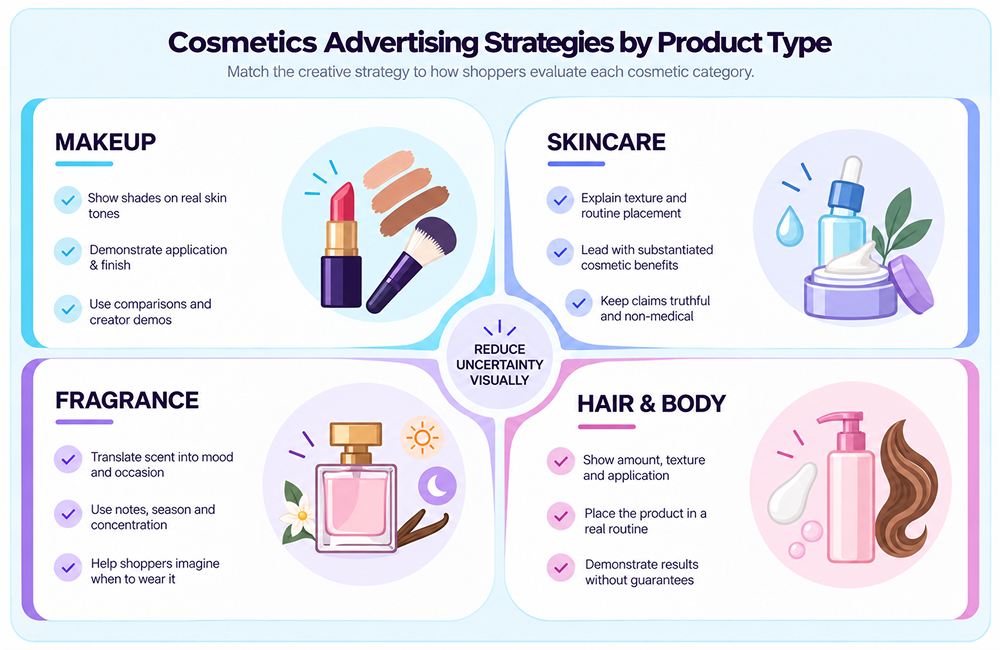
Makeup Advertising
Makeup ads have an unusually high information burden because shoppers cannot physically test the product through the screen. Reduce uncertainty visually.
- Show shades on representative skin tones rather than relying on the package color alone.
- Demonstrate application and finish under realistic lighting.
- Use side-by-side comparisons when shoppers need to choose between finishes or shades.
- Show the product in the context where it is intended to be used.
- Use creator content to answer practical application questions.
Skincare Product Advertising
Skincare advertising needs a careful balance between education and claims. Lead with the product's intended cosmetic benefit and explain how it fits into a routine. Avoid turning ordinary cosmetic messaging into a medical promise.
For example, instead of building an ad around a dramatic promise about treating a condition, focus on the formulation, texture, intended use, routine placement, and substantiated cosmetic benefit. In the United States, FDA notes that cosmetic claims must be truthful and not misleading and that claims about treating or preventing disease or affecting the structure or function of the body can move a product into drug territory.
Fragrance Advertising
Fragrance cannot be demonstrated digitally in the same way as foundation or serum. The creative therefore has to translate the product experience into a clear mental picture.
Use scent notes, mood, occasion, season, concentration, and product presentation to give the shopper context. A useful fragrance ad does not simply say that the scent is 'luxurious'; it gives the buyer a reason to imagine when and why they would wear it.
Hair and Body Cosmetic Advertising
For hair and body products, demonstrations can carry much of the message. Show the product amount, application method, texture, and routine context. If the result is visually demonstrable, show it without implying that every customer will experience an identical outcome.
Cosmetic Ad Creative Formats Worth Testing
UGC-style review: A customer or creator explains what they bought, how they use it, and what they like about it. Best when the product needs social proof.
Application demonstration: The product is shown being applied from start to finish. Useful for makeup, skincare, hair, and body products.
Problem-to-product video: Start with a real product-selection problem and demonstrate how the product fits the use case.
Product comparison: Compare shades, finishes, formats, or routine roles. The comparison should be factual and easy to understand.
Founder or expert explanation: Use when formulation, sourcing, product development, or usage needs more context.
Offer-led static: Lead with a clear product and commercial offer. Keep the design focused on the product and the reason to act.
Carousel: Use multiple frames to move through product benefits, shades, ingredients, reviews, or bundle contents.
Tutorial: Teach the buyer how to use the product correctly. This can reduce purchase anxiety and create content that remains useful beyond the paid campaign.
Cosmetics Advertising Examples: What the Campaign Structure Should Look Like
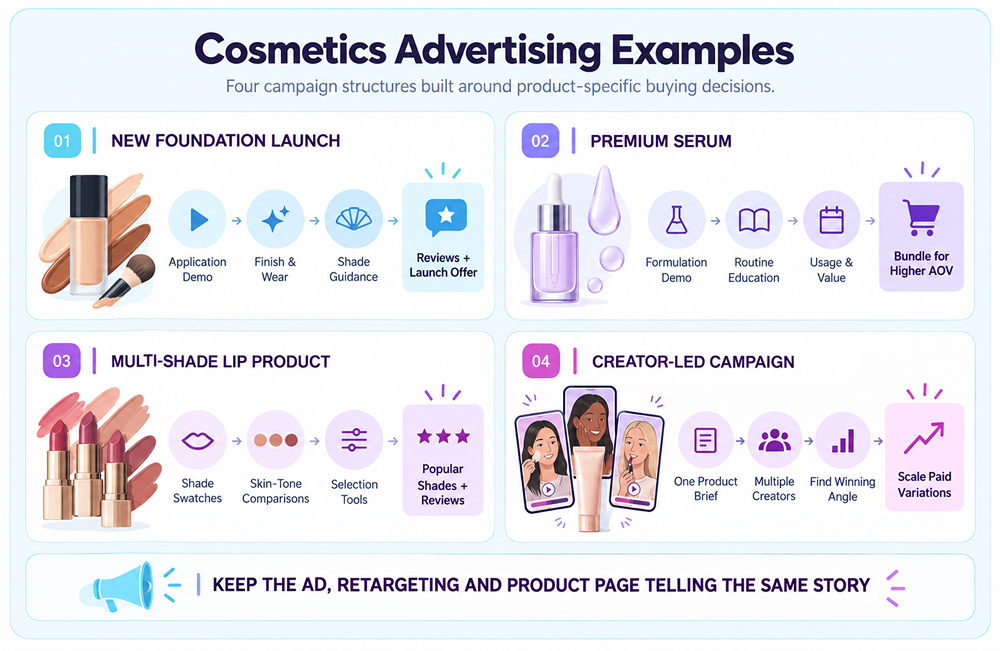
Example 1: New foundation launch
Ad 1 introduces the foundation with a short application demonstration. Ad 2 focuses on finish and wear context. Ad 3 answers shade-selection questions. Retargeting then uses reviews and the launch offer. The product page mirrors those same messages so the shopper does not have to search for the information.
Example 2: Serum with a higher price point
Cold traffic sees a formulation-focused demonstration rather than an immediate discount. A second creative explains how the product fits into a routine. Retargeting answers questions about usage, size, and value. A bundle can then raise order value without positioning the product as permanently discounted.
Example 3: Lip product with many shades
The campaign focuses on reducing choice anxiety. Creative shows a selection of shades on representative skin tones, while the landing page provides shade descriptions and comparison tools. Retargeting can highlight the most popular shades and customer reviews.
Example 4: Creator-led product campaign
Following the right approach for influencer marketing is crucial. Several creators receive the same product brief but produce different demonstrations. The brand identifies which product angle generates qualified traffic and then creates additional paid variations around that angle rather than simply choosing the creator with the highest follower count.
Cosmetic Advertising Claims and Compliance
Cosmetics brands should treat claims as part of campaign development, not as copywriting decoration. A claim that sounds persuasive can create a legal or platform problem if it is inaccurate, misleading, or unsupported.
In the United States, the FDA explains that cosmetic labeling claims must be truthful and not misleading. FDA also distinguishes cosmetic claims from claims about treating or preventing disease or affecting the structure or function of the body, which can cause a product to be regulated as a drug.
Platform rules also matter. Google states that its advertising policies cover prohibited content, prohibited practices, restricted content, and editorial/technical standards, and advertisers are responsible for complying with applicable laws and policies.
If personalized advertising or audience data is involved, review the platform's current targeting restrictions as well. Google maintains restrictions for sensitive interest categories and specific audience features.
For creator campaigns, endorsements should reflect the creator's honest experience and should not make claims that the advertiser could not substantiate directly. Material connections should also be disclosed where applicable.
Because requirements vary by market, product, and claim, the final campaign should be reviewed against the rules that apply to the country where the ad will run.
30-Day Cosmetics Advertising Testing Plan

For a brand starting with limited historical data, the first month should be treated as a structured learning period rather than a race to scale.
Week 1: Message and tracking: Confirm conversion tracking, product economics, and the primary campaign goal. Build three to five creative concepts around different product angles. Make sure the landing page matches the campaign message.
Week 2: Creative testing: Launch the strongest concepts and watch for meaningful differences in click quality and conversion behavior. Avoid changing several major variables at once.
Week 3: Funnel optimization: Identify whether the main constraint is creative, traffic cost, product-page conversion, or offer economics. Improve the weakest stage and produce new creative based on what the first tests taught you.
Week 4: Consolidation: Shift attention toward the strongest product angles and creative concepts. Keep testing new variations so the account does not depend on one ad. Review acquisition economics and decide whether the campaign is ready for controlled scaling.
Common Cosmetics Advertising Mistakes
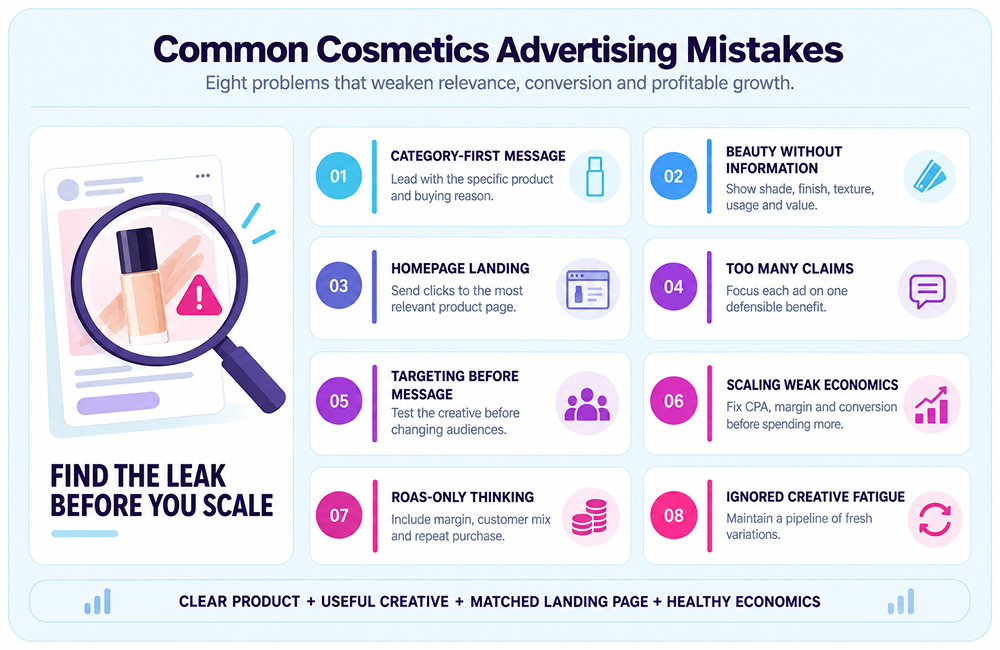
Advertising the category instead of the product: A vague 'upgrade your beauty routine' message does not tell the shopper what is being sold or why it matters.
Using attractive imagery without product information: A polished image can earn attention while leaving the buyer unable to judge shade, finish, texture, usage, or value.
Sending every click to the homepage: The more specific the ad, the more specific the landing page should be.
Making too many claims in one ad: One defensible benefit is usually easier to understand and test than a list of unsupported promises.
Testing audiences before testing the message: If the creative is weak, changing targeting can hide the real problem rather than solve it.
Scaling before the economics work: More budget increases the size of the problem if CPA, margin, or conversion rate is already unacceptable.
Treating ROAS as the only business metric: Discounts, gross margin, new-customer mix, and repeat purchase can change the actual value of an acquisition.
Letting creative fatigue go unnoticed: A previously successful concept can weaken as the audience sees it repeatedly. Maintain a pipeline of new variations.
Final Takeaway
The strongest cosmetics advertising campaigns do not begin with a platform or a trendy ad format. They begin with a specific product, a clear reason someone would buy it, and an understanding of what the shopper needs to believe before purchasing.
From there, build the campaign in a sequence: choose the product, define the angle, match the channel to buying intent, demonstrate the product, connect the ad to a relevant landing page, measure the full funnel, and test one meaningful variable at a time. When something underperforms, diagnose the stage of the funnel before increasing spend.
If you need help creating, managing, or optimizing cosmetic advertising campaigns, consult with our experts at Brenton Way to develop a strategy built around your products, audience, and growth goals.
FAQs
How do you advertise cosmetics?
Choose a specific product and campaign goal, define the buyer's purchase need, select channels based on intent, create product-focused ads, send traffic to a matching product page, track purchases and revenue, and optimize the weakest stage of the funnel.
What are the best platforms for cosmetics advertising?
There is no single best platform for every cosmetic product. Google Search and Shopping can capture existing product demand, while Meta and TikTok can support visual discovery, UGC, and creative testing. YouTube can be useful when demonstrations and education require more time.
How do you make cosmetic ads more effective?
Make the product the center of the creative. Demonstrate how it is used, communicate one meaningful benefit, show proof where appropriate, make the offer clear, and ensure the landing page answers the same questions raised by the ad.
What should a cosmetic product ad include?
The product, a clear reason to care, a visual demonstration or strong product image, credible proof where relevant, a clear offer when applicable, and a direct next step.
What keywords should a cosmetics advertising campaign target?
Keyword selection depends on the product. Build around product-specific and high-intent searches rather than relying only on broad terms. Examples can include product type, product category, use case, shade or format terms where relevant.
What is the difference between cosmetics advertising and beauty advertising?
Cosmetics advertising is primarily product-focused, covering paid promotion of cosmetics such as makeup, skincare, and fragrance. Beauty advertising is broader and can cover the wider beauty category, brands, services, trends, and industry-level marketing.
How much should a cosmetic brand spend on ads?
There is no universal budget. Start from the economics of the product, average order value, contribution margin, target acquisition cost, and conversion rate, and spend enough to gather useful data without assuming the campaign will automatically scale profitably.
Let's Grow Your Brand With Us
Book a free consultation and get a custom growth strategy tailored to your business.
Book Free ConsultationGet marketing insights in your inbox
Join our newsletter for the latest digital marketing tips and strategies.
By subscribing, you agree to our Privacy policy .

About the author
Joydeep BhattacharyaContent Writer at Brenton Way
Joydeep Bhattacharya is an SEO strategist, SEOsandwitch founder, and Semrush contributing author with more than a decade of experience in search and content marketing.


