Newsletter Brenton Way Growth Hour #93 7 min read
The Paid Search Team Got a New Tab
OpenAI is turning ChatGPT ads from a novelty placement into a real acquisition channel. Ecommerce teams need to stop treating it like AI news and start treating it like the early version of a new search auction.
Paid search did not die. It learned how to talk.


Editor's Note
The short version
ChatGPT ads are starting to look less like an experiment and more like a new paid search surface. The practical takeaway for ecommerce teams is simple: clean product data, source-backed copy, and measurement readiness matter before budgets move.
The Lead
Somewhere inside a paid search Slack channel, a very tired media buyer just got assigned another platform.
Not a new campaign type.
Not a new Meta placement pretending to be strategy.
A whole new tab to panic in.
OpenAI is rolling out ChatGPT ad tools that look suspiciously like the early days of paid search, except the search box talks back and already knows what the buyer is trying to solve.
The update includes beta self-serve Ads Manager access, CPC bidding, conversion tracking, and expanded advertiser access, according to OpenAI.
Retailers and ecommerce teams should treat the product catalog as more than a backend feed. Product names, images, pricing, availability, and attributes are becoming inputs for ad generation, matching, and measurement.
That sounds boring until you realize what just happened.
Your product feed is no longer just a data layer. It is creative. It is targeting. It is bidding fuel. It is the thing standing between your brand and a buyer asking, "What should I buy?"
The paid search team spent 20 years learning how to win the keyword.
Now the keyword has become a conversation.
And OpenAI just added an ad product next to it.
Paid search did not die. It learned how to talk.
Key Shift
The old search auction was built around keywords. The new one is built around intent.
That difference matters because a keyword tells you what someone typed. A conversation tells you what someone is trying to do.
OpenAI says ads are currently rolling out in the US, with expansion to Australia, New Zealand, and Canada expected soon. Ads may appear for users on Free and Go plans; Plus, Pro, Business, Enterprise, and Edu accounts will not have ads.
That gives advertisers a strange new surface: high-intent users asking for help, but inside an environment where the ad cannot feel like a banner duct-taped to the bottom of the answer.
Framework
The Conversation Auction
A 4-layer model for understanding how ChatGPT ads change ecommerce acquisition.
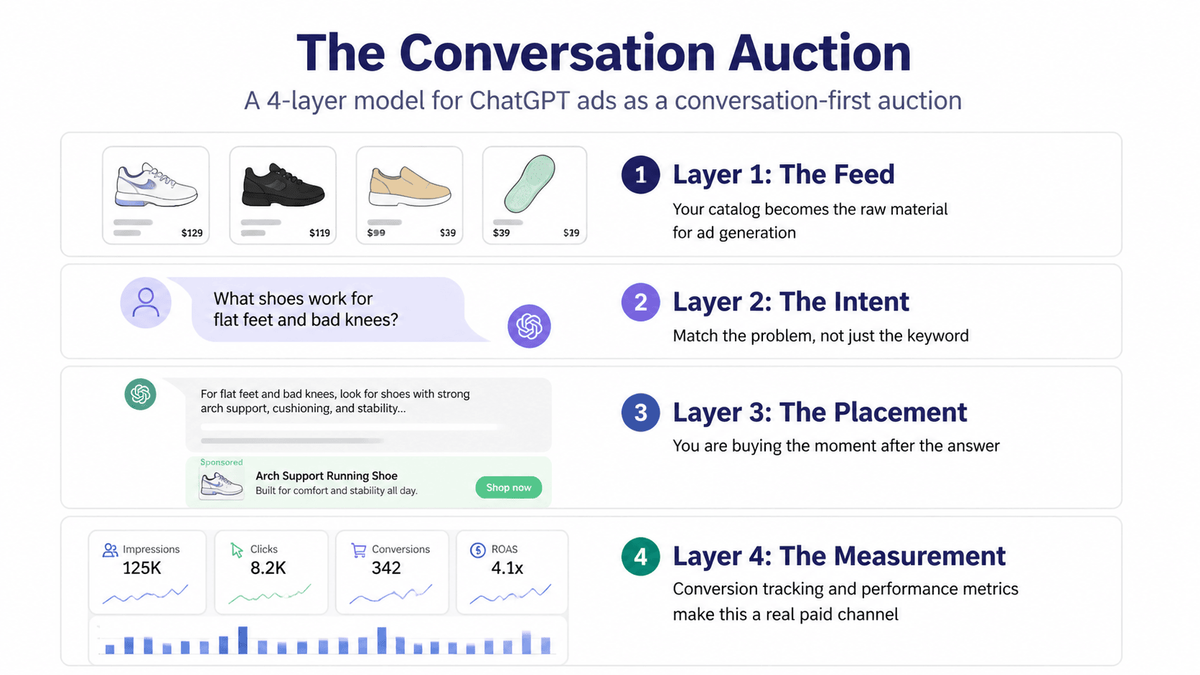
1. The Feed
Your product catalog becomes the raw material for ad generation. If your product names, images, attributes, pricing, and availability are sloppy, the ad system has nothing clean to work with.
2. The Intent
The buyer is not typing "running shoes size 10." They are asking what shoes work for flat feet, bad knees, summer training, or a half marathon they regret signing up for. The ad has to match the problem, not just the product category.
3. The Placement
ChatGPT ads appear below responses and are labeled as sponsored. That means the placement is visible, but not native in the same way an organic recommendation is. You are not buying the answer yet. You are buying the moment after the answer.
4. The Measurement
OpenAI has introduced Conversions API and pixel-based measurement. That is the part that makes this real for performance teams. Nobody wants another awareness channel with a dashboard full of decorative numbers.
Short-term wins are on Layer 1. The opportunity is owning all four.
Platform Shift
ChatGPT, Rufus, and AI Mode Read Differently Than Google
OpenAI added CPC bidding after initially supporting CPM buying, meaning advertisers can now pay when users click instead of only buying impressions.
It also listed Adobe, Criteo, Kargo, Pacvue, and StackAdapt among technology partners supporting access to ChatGPT ads. Criteo is OpenAI's first ad tech partner for the format.
AI shopping engines do not rank the way a directory list does. They assemble answers from product attributes, reviews, editorial context, and structured data.
Amazon Rufus pulls from listing attributes, Q+A content, and reviews. ChatGPT and Google AI Mode can compare public discussions, third-party context, and product pages in ways that are less linear than a classic search results page.
None of these experiences treat brand.com as automatically the best answer because it ranks highest in traditional search.
What this means for performance marketers:
- Product detail pages need to be written for machine parsing.
- Review profiles are becoming creative inputs, not just social proof.
- Third-party mentions matter in ways they never did for SEO.
- Search ranking is not recommendation ranking.
The growth team that wins is the one that stops optimizing for the index and starts optimizing for the model.
Bridge Report
The Bridge Report: Where Marketers Find Momentum
When a new acquisition channel appears, the first mistake is treating it like a separate toy. The second mistake is letting the platform grade its own homework. Bridge helps growth teams connect new traffic sources back to the numbers that actually matter.
Community Corner
Question for the group
If ChatGPT ads showed up in your ad account tomorrow, who would own it?
Paid search, ecommerce, retention, or the person who "knows AI"?
Reply with the team. Best answer gets featured next week.
Fast Four
Four quick shifts marketers should pay attention to this week.
Shifts are ranked by how strongly they signal movement toward AI-assisted commerce and retail media.
Google AI Mode ad surfaces are starting to expand.
Google is introducing new Gemini-powered ad formats across AI Mode and Search, signaling that commerce will be monetized inside AI-generated answers.
Source: Search Engine LandShopify ecosystem discovery is moving into context.
Shopify merchants are preparing for AI-assisted shopping experiences where product data quality, availability, and structured attributes affect discovery.
Source: Shopify Help CenterGoogle Marketing Live pushed AI ads higher on the agenda.
Performance teams should expect more AI-generated creative, Shopping integrations, and conversational ad formats to work their way into campaign planning.
Source: Google Marketing PlatformDollar General expands in-store audio ads.
Mars United Commerce reported that Dollar General Media Network is expanding its in-store audio footprint, another sign retail media is moving beyond digital placements.
Source: Mars UnitedFrom Our Partner Network
Brenton Way
Brenton Way helps growth-stage brands turn messy acquisition shifts into measurable revenue systems. When platforms add new surfaces, new attribution gaps, and new ways to spend money before anyone knows what works, Brenton Way helps teams rebuild the strategy before the budget gets volunteered as tribute.
What To Test This Week
Run the audit before the surface gets crowded.
- Pull your Google Shopping feed and audit missing or thin product attributes.
- Ask GPT-4o to describe 10 top SKUs using only publicly available data. If it gets basic details wrong, your structured data has gaps.
- Check whether your top categories surface your products in Rufus, Google AI Mode, and ChatGPT shopping-style prompts.
- Identify Reddit or review threads that outrank your product pages for high-intent queries and decide if they are helping or hurting.
- Set a recurring alert for product feed errors before connecting any new AI ad surface.
That is everything for this edition.