Long-Tail Keyword Strategy: How to Prioritize Topics That Can Create Pipeline

TL;DR
Prioritize long-tail searches by buyer fit, intent, and evidence, then improve or build the page that answers the buyer’s next question. Give readers one clear next step and track which organic visits become qualified leads and opportunities.

Ask AI about this
Get an AI-powered summary of this article
Table of Contents
A strong long-tail keyword strategy starts with the questions your best customers ask before choosing a solution.
The goal is not to publish more pages or chase low-volume phrases; it is to identify searches that reflect a real business need, match them with the right experience, and measure what happens next.
At Brenton Way, we look beyond search volume to understand what potential customers are searching for, what they need to make a decision, and where meaningful opportunities exist.
Here’s how we identify the topics worth investing in and turn them into a more focused content strategy.
Start with the customer problem
Before we pull keyword ideas, we identify the audience the business needs to attract and the decision that audience is trying to make. Sales calls, CRM notes, objections, customer interviews, reviews, support conversations, and lost-deal reasons can reveal how buyers describe the problem and what prevents them from moving forward.
We turn those inputs into research themes: understanding a problem, comparing solutions, assessing cost, evaluating providers, and validating trust. These are directions for investigation, not automatic content assignments.
- Who is the right-fit buyer, and what makes them a fit?
- What situation prompts the search?
- What question must be answered before the buyer can proceed?
- What proof, criteria, or reassurance does that buyer need?
- Which service, product, or resource can genuinely help?
Validate the opportunity with search and business data
Keyword research helps us identify opportunities, but search volume alone doesn't reveal business value. We assess search intent, customer needs, and business relevance to prioritize topics that can attract the right audience and support growth.
Use first-party search performance
In Google Search Console, review query and page reports for relevant impressions, clicks, and average position. Look for qualified topic patterns already generating visibility, pages appearing for an unintended audience, and query groups that suggest an existing page is not fully answering the need. Compare like-for-like periods and account for seasonality.
Search Console’s Performance report helps us find which queries and pages earn visibility. Those metrics show discoverability, not pipeline by themselves. We connect them with analytics and CRM stages before concluding commercial value.
In the Performance report, select a relevant search term under Queries, then switch to Pages to see which URLs appeared for that search. Follow Google’s walkthrough.
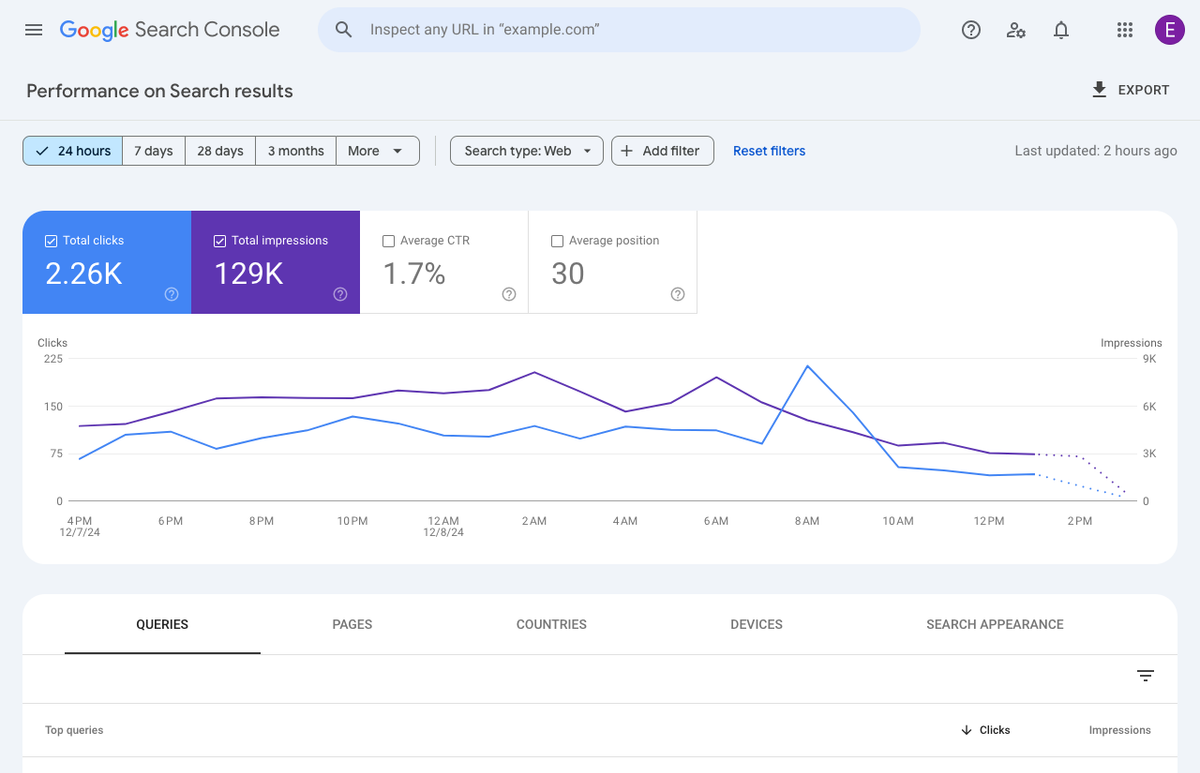
View the full-size Performance report screenshot · Google Search Central source
Review the results page before assigning a format
Inspect current results for each priority query. If Google surfaces provider pages and vendor comparisons, a broad educational article may miss the searcher’s task. If results emphasize detailed guides, a commercial page alone may not answer the question. Note recurring formats, questions, proof points, and gaps competitors leave unresolved.
A long-tail phrase is not a mandate to publish a blog. The better outcome may be a more complete service page, a clearer pricing resource, a consolidated guide, or no new page.
See how the page changes with the buyer’s question. Our SEO pricing guide explains how competition and site condition affect costs. Our SEO services page explains the work and offers an audit for buyers evaluating a provider.
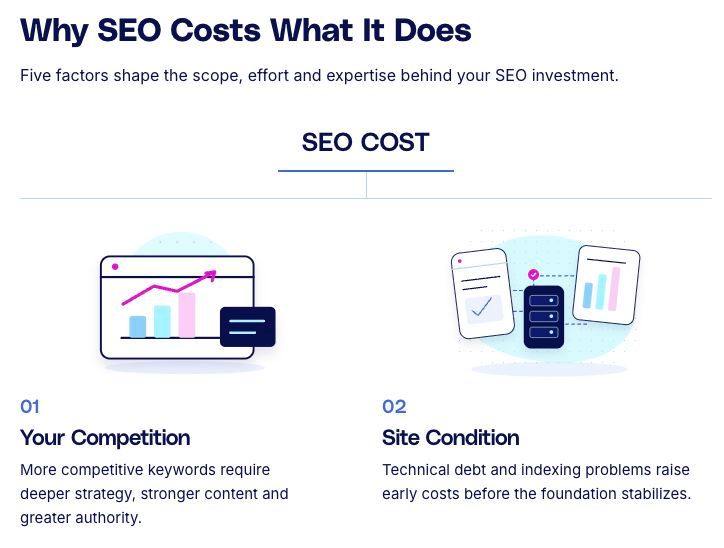
View the full-size pricing guide screenshot
Connect search activity with lead quality
Where tracking allows, map landing-page engagement to qualified inquiries, sales acceptance, opportunity creation, and closed revenue. Keep sourced pipeline separate from influenced pipeline, define attribution windows, and flag measurement gaps. An inquiry is not automatically qualified, and pipeline should not be attributed to SEO alone unless the evidence supports that conclusion.
Prioritize topics by fit, evidence, and usefulness
We prioritize topics using customer fit, intent, business relevance, supporting evidence, and our ability to provide a useful answer. Search volume and keyword difficulty inform the assessment without determining the roadmap. Rate each topic against the same criteria, then discuss high-value exceptions with the team. The score is a decision aid, not a forecast.
Signal | Questions to assess | Suggested weight |
Customer fit | Does this search come from a customer we can serve well? | 30% |
Intent clarity | Is the need and next decision clear from the query and results? | 20% |
Business connection | Is there a credible route from this need to our offer? | 20% |
Evidence | Do customer conversations, search data, or CRM signals support our long-tail keyword research findings? | 15% |
Ability to win | Can we provide a more useful answer with realistic resources? | 15% |
Score each criterion from 1 to 5, multiply by its weight, and sort the resulting priorities. Treat missing evidence as uncertainty, not as a zero-demand verdict. Confirm the shortlist against search results, content inventory, seasonality, and available resources before committing.
Map search intent to the right page
A keyword tells us what someone searches for, but the search results help us understand what they expect to find. Before assigning a topic to a page, we review the intent behind the query and the content already ranking for it.
For example, someone searching for a solution to a specific problem may need a practical guide, while someone comparing providers is more likely to need service details, relevant experience, pricing information, or proof of results. Searches around implementation or cost may call for a dedicated resource if the information cannot be covered clearly elsewhere.
We also review our existing pages before planning new content. If a page already serves the same audience and purpose, improving it may be more valuable than creating another URL. We create a separate page when the search intent is meaningfully different and we can offer information that genuinely deserves its own place in our SEO strategy.
Make the page decision before writing
Do not merge pages just because they share words, and do not create a URL for every variation. Base the decision on the searcher’s need, the result format, existing site architecture, performance signals, and whether we can add something distinct, while following our technical SEO checklist to identify issues that may affect performance.
Decision | Use it when | Next action |
Improve | An existing URL matches intent and already has relevant visibility, links, or context. | Fill answer gaps, strengthen proof and clarity, improve experience, and refine the next step. |
Consolidate | Multiple URLs substantially overlap and serve the same purpose. | Review query and backlink signals, preserve unique value, choose a destination, and plan redirects and internal links. |
Create | The need is distinct, results support a separate resource, and we can add meaningful value. | Set the audience, page promise, evidence, related commercial destination, and success measure. |
Defer | Buyer fit is weak, value is uncertain, the answer would not be differentiated, or no credible next step exists. | Validate further or remove it from the active roadmap. |
How to choose between two commercial searches

Say you sell SEO services to multi-location dental practices. Sales calls keep surfacing the same question: “What would SEO cost across all our locations?” You have two topics on the shortlist. Score both using the criteria above.
Search | Customer fit | Intent clarity | Business connection | Evidence | Ability to win | Weighted score |
|---|---|---|---|---|---|---|
SEO pricing for multi-location dental practices | 5 | 5 | 4 | 5 | 4 | 4.65 / 5 |
SEO agency for multi-location dental practices | 5 | 4 | 5 | 2 | 3 | 4.05 / 5 |
Illustrative scores. Use your own sales notes, search results, and page inventory.
Start with pricing. Buyers are already asking about it, and you can give them a concrete answer: how location count affects scope, what setup and ongoing work include, and what information they need to compare quotes. If search results favor pricing guides and you already have one that serves this audience, improve that page first. Give readers one next step: Request a scope estimate for your locations.
Before the update goes live, record the page’s current organic inquiries and opportunities. Capture the original landing page and traffic source when someone submits the estimate form. In the CRM, count a lead as qualified once sales confirms it serves multiple locations and has a need your team can support. After one sales cycle, review how many of those leads became opportunities. Report opportunities that started with organic search separately from those where the guide assisted a buyer who arrived through another channel. Use Search Console to check whether pricing queries gained visibility, and use the CRM to judge the page’s contribution to pipeline.
Create content that helps customers make decisions
Once we identify a worthwhile topic, we determine what the reader actually needs from the page. Someone comparing solutions may need selection criteria, pricing considerations, limitations, or evidence before moving forward. Our content marketing approach addresses those questions with useful detail and a clear next step to help readers make informed decisions.
For TePe USA, we developed educational content around product benefits as part of a broader SEO and website improvement program. The work helped the website rank for more than 1,200 new keywords, while the combined campaign reported a 330% increase in SEO traffic.

That is why we evaluate content opportunities by the value they deliver to the visitor, not simply by the number of keywords a page can rank for. When an existing product or service page can answer the question better, we prioritize improving that experience over publishing another article.
Build a relevant next step into the content
Assign every page one clear job. A problem-solving guide can direct readers to a deeper evaluation resource. A comparison page can link to a relevant service explanation or proof point. A service page should answer fit, process, scope, evidence, and what happens next.
Internal links should follow the reader’s question. Use descriptive anchor text, avoid repetitive exact-match links, and do not send every article to the same destination simply to add a link.
Measure progress beyond rankings

Set a baseline before publishing or changing a page. Track the signals that explain both search performance and business value:
- Visibility: query impressions, clicks, landing-page trends, and ranking movement.
- Page usefulness: relevant engagement and progression to the next step.
- Lead quality: qualified conversion, sales acceptance, and fit.
- Pipeline: opportunity and revenue contribution, with sourced and influenced pipeline measured separately using defined attribution windows.
Review performance on a cadence that respects the sales cycle, and use conversion optimization to investigate friction when relevant visitors are not progressing to the next step. If performance is weak, diagnose the likely constraint, intent mismatch, low visibility, missing proof, poor page experience, or conversion friction, before commissioning more content. Record the hypothesis, change, date, owner, and outcome so the learning carries into the next sprint.
A Practical Workflow for the Next Keyword Sprint
1. Define Strategic Focus & Target Audience
Select a priority commercial offer and precisely map out its right-fit audience, addressing their core pain points, search behaviors, and buying stage.
2. Aggregate Data & Voice-of-Customer Insights
Collect recurring customer questions from support tickets and sales calls, combining them with quantitative search query data to capture real user language.
3. Cluster by Intent and Decision Stage
Group search queries by user intent and decision-making criteria (e.g., informational, transactional) rather than focusing solely on exact-match wording.
4. Conduct an Asset & SERP Audit
Review current search engine results pages (SERPs) and audit your existing URLs to identify content gaps, thin pages, or cannibalization risks.
5. Apply the Content Decision Matrix
Determine the most strategic action for each topic cluster: improve (update and expand), consolidate (merge overlapping pages), create (build a new asset), or defer (deprioritize).
6. Map Execution & Accountability
Define the internal linking architecture, primary conversion path, current performance baseline, designated content owner, and key measurement metrics.
7. Evaluate Performance Before Scaling
Review early visibility, ranking momentum, and lead-quality evidence before expanding into broader topic clusters or adjacent sub-topics.
Turning keyword research into meaningful growth
A long-tail keyword strategy works best when every content decision has a clear purpose. By understanding what customers are searching for, identifying the opportunities worth pursuing, and building pages that meet those needs, we can make organic search a more meaningful part of business growth.
At Brenton Way, we focus on helping businesses move beyond keyword lists and build content strategies that support search visibility, relevant traffic, and qualified lead generation. The goal is to invest in content that serves both the customer and the business.
Already have a shortlist? Get a second opinion on your SEO priorities.
Frequently asked questions
Are long-tail keywords always low-volume?
Long-tail keywords are relatively low-frequency searches in the tail of the search demand curve. There is no universal monthly search-volume cutoff, and word count alone does not make a query long-tail. These searches are often specific, but they are not automatically easier to rank for or more likely to convert. Evaluate search intent, buyer fit, and competition alongside estimated volume.
Should every long-tail keyword have a separate page?
No. Group queries that share intent and the same expected answer. Create a separate page only when the need is meaningfully distinct and the page can add value.
How can we tell whether a keyword can create pipeline?
Keyword tools cannot prove pipeline potential. Validate buyer fit and commercial relevance through customer research, tracking, and CRM outcomes. Use the evidence to update prioritization over time.
How quickly will SEO results appear?
There is no guaranteed timeline. Competition, technical health, site history, content quality, authority, and buying cycles all matter. Set expectations from the current baseline and evaluate early visibility alongside qualified conversion signals.
Let's Grow Your Brand With Us
Book a free consultation and get a custom growth strategy tailored to your business.
Book Free ConsultationGet marketing insights in your inbox
Join our newsletter for the latest digital marketing tips and strategies.
By subscribing, you agree to our Privacy policy .

About the author
Jonathan SaeidianHead of Strategy at Brenton Way
Jonathan Saeidian is the founder of Brenton Way, Bridge, and Growth Virality, where he builds measurable growth marketing systems for startups, scaleups, and enterprise teams.


