How Much Does a Growth Marketing Agency Cost?

TL;DR
For a mid-market brand, a growth marketing agency costs $6,000–$25,000 per month. Compare proposals by scope, team seniority, and documented results, and budget separately for ad spend and paid media management fees.

Ask AI about this
Get an AI-powered summary of this article
Table of Contents
How Much Does a Growth Marketing Agency Cost?
A growth marketing agency costs between $6,000 and $25,000 per month for a mid-market brand. A generalist digital marketing agency costs less, usually between $2,500 and $12,000. Enterprise programs start at $15,000 and can cost up to $30,000.
In this guide, we break down exactly what growth marketing agencies charge, how they structure their pricing, what you get at each budget level, and how to tell whether an agency is worth what they are quoting you.
Growth Digital Marketing Agency Pricing at a Glance
Engagement Type | Typical Monthly Cost |
|---|---|
Generalist digital marketing agency | $2,500 to $12,000 |
Growth marketing agency, 1 to 2 channels | $3,000 to $8,000 |
Growth marketing agency, full-funnel | $8,000 to $15,000 |
Enterprise growth program | $15,000 to $50,000+ |
Hourly consulting | $100 to $300 per hour |
Standalone growth audit | $1,500 to $5,000 |
Note that the same budget can get you completely different things depending on the agency.
For instance, an $8,000 per month retainer from a growth marketing agency with a senior team and a documented track record is not the same as $8,000 per month from a generalist agency. The cost might be the same, but the outcome will not be.
The table also does not account for ad spend. If the agency offers paid media, expect a management fee of 10 to 20% of your monthly ad budget in addition to the base retainer.
So, if you budget $20,000 in monthly ad spend, that is an additional $2,000 to $4,000 per month before the retainer is even factored in.
And finally, keep in mind that hourly consulting rates are almost meaningless without knowing the consultant's expertise and experience. A senior growth strategist charging $250 per hour can find and fix a problem in two hours that a junior consultant at $100 per hour might take two weeks to solve. This means a lower hourly rate doesn't mean a lower overall cost.
Pricing Models: How Growth Marketing Agencies Charge
$8K–$12K / month
Fixed monthly fee for ongoing strategy, execution and reporting.
Best for continuous, cross-channel growth
10%–15% of attributed revenue
Base fee plus ad-spend percentage or revenue share.
Align incentives with profitable business outcomes
$1.5K–$50K / project
One-time pricing for audits, strategy or campaign build-outs.
Best for a defined scope and ready-to-execute team
Before you compare prices, you need to understand how agencies structure their fees. The pricing model influences what you are buying, what the agency is incentivized to do, and how easy it is to evaluate whether you are getting value.
Most agencies offer one of three models.
Monthly Retainer
This is how 78% of agencies bill their clients in 2026. In this model, you pay a fixed monthly fee, and the agency handles strategy, execution, and reporting on an ongoing basis.
This is the most common model because growth marketing isn't a one-time project. The longer an agency works with you, the more campaign data they have, the better the targeting gets, and the lower your cost per acquisition.
For example, a mid-market retainer at $8,000 to $12,000 per month will cover paid media across Meta and Google, weekly social media marketing production, conversion rate optimization on key landing pages, email marketing and lifecycle sequences, and a monthly strategy review.
The most important thing here is that it all runs from the same plan. The paid media team and the email team are working toward the same acquisition and retention targets, not optimizing their own channel in isolation.
Performance-Based
Some agencies attach their fees to results. Usually a base retainer plus a percentage of ad spend, or a revenue share.
A reasonable benchmark is a retainer that costs less than 10%-15% of the revenue the agency is responsible for creating. So if an agency is managing a growth program that generates $100,000 a month in attributed revenue, they get a fee of $10,000 to $15,000.
For this model, watch what the agency is being paid to do. If they earn more when your ad spend goes up, they have a reason to recommend increasing your budget even when it is not the right move.
If they earn a cut of revenue, they may push for more short-term conversions, even when that negatively affects your margins. Before you agree to any performance marketing agency and structure, make sure the metric they get paid on is the same one that improves your business.
Project-Based
Some engagements are one-off. A growth audit or diagnostic typically costs $1,500 to $5,000. A full channel strategy, a campaign build-out, or conversion optimization costs $5,000 to $50,000 depending on the scope.
Project pricing is recommended when you have a specific problem and a team ready to execute the output.
A brand that needs a full SEO and content marketing strategy built before committing to a retainer, or one that wants a paid media audit, should start with this model. But note that this model does not replace ongoing strategy. A one-off campaign will not produce compounding results. Growth marketing requires continuity to work.
Factors Affecting Agency Costs
-
01 Number of Channels
More channels require more specialists, hours and reporting.
1–2 channels: $3K–$8K / month. Full service: $8K–$15K / month.
-
02 Industry Competition
Complex and competitive categories need deeper expertise, content and measurement.
More complexity = higher cost
-
03 Agency Location
Senior US and UK teams generally cost more than offshore providers.
Price should match the expertise needed
-
04 Engagement Length
Longer partnerships build campaign knowledge and improve decision-making.
More data. Faster decisions. More value.
Two businesses in the same industry can get different quotes from the same agency because of business needs, market competitiveness, and who does the work.
Below are the major factors that affect agency costs.
The Number of Channels You Need
The more channels you need to manage, the more it costs.
One or two channels, like paid search and email, can cost $3,000 to $8,000 per month. Complete marketing services that include paid media, creative production, SEO services, email, and lifecycle marketing can cost $8,000 to $15,000.
Every channel you add means more hours, more reporting, more people, and more marketing costs.
Your Industry and How Competitive It Is
Some industries are simply harder and more expensive to market in than others.
For instance, a healthcare brand, a fintech company, or a B2B brand with a six-month sales cycle all require more specialized strategy, more carefully produced content, and more rigorous measurement than an ecommerce brand selling a single product.
The more competitive and complex your category, the more the work costs.
Your Location and the Agency's
Where the agency is based affects what you pay. A US- or UK-based agency with senior staff costs more than an offshore provider.
An offshore team can handle content formatting, reporting, and basic technical work efficiently. They rarely match a senior US or European strategist on competitive positioning, campaign diagnosis, or category-specific expertise.
Know your marketing goals before you decide whether the price difference is worth it.
The Length of the Engagement
Growth marketing gets cheaper the longer it runs. Not because agencies lower their rates, but because the work compounds.
An agency that has run your paid media for 12 months has tested hundreds of creative variations, knows which audiences convert, and can make faster, more accurate decisions.
A new agency spends the first three to four months learning your business. That learning curve costs money because every test, every failed ad, and every week spent figuring out your audience is budget that a more experienced partner would have spent scaling what already works. The longer you stay with the right agency, the more value you extract from the same monthly fee.
What Your Budget Gets You Per Month
Not all marketing companies charge the same because not all of them offer the same digital marketing strategies. Here is exactly what your budget gets you at each level,
Budget | Who it suits | What is included | What is not included |
|---|---|---|---|
Under $2,500/month | Nobody | Basic reporting, templated strategy | Execution depth, link building, senior strategy, anything that compounds |
$2,500 to $6,000/month | Early-stage businesses testing a channel | One to two channels, mid-level execution, monthly reporting | Senior strategic involvement, attribution connected to revenue |
$6,000 to $15,000/month | Growing mid-market brands | Full-funnel strategy, paid media, creative, conversion optimization, lifecycle, weekly reporting | Multi-market programs, enterprise-scale technical management |
$15,000 to $30,000/month | Scaling brands competing nationally | High-volume creative testing, multi-channel acquisition, senior strategist, revenue-connected reporting | International SEO, multi-site management, engineering coordination |
$30,000 and above | Enterprise brands | Everything. Multi-market, engineering alignment, specialist content, full attribution modeling | Nothing. This is a full-service program. |
Digital Marketing Costs: Agency vs In-House
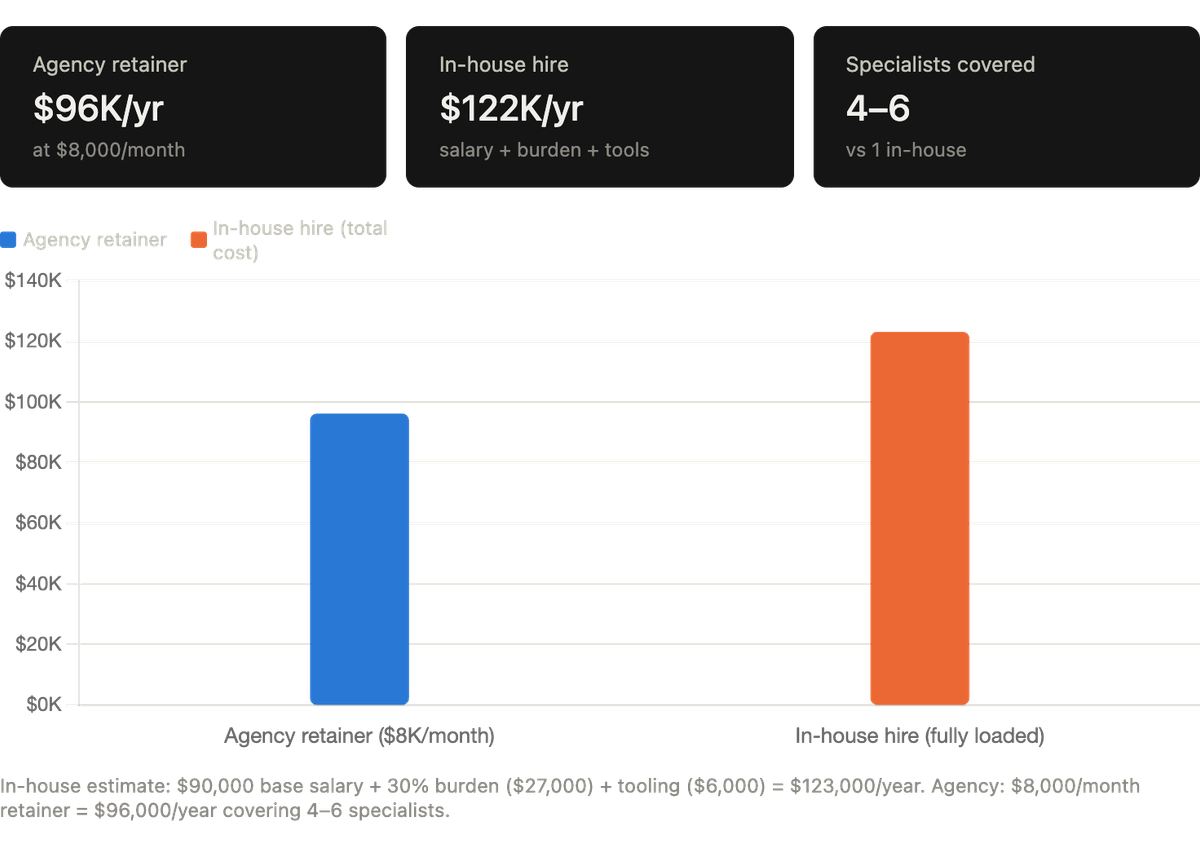
Your first instinct is to look at a $10,000-per-month agency retainer and think that is expensive. Then compare it against hiring someone. A marketing manager sounds cheaper until you do the full maths.
A US marketing hire with three years of relevant experience costs $70,000 to $110,000 in base salary. Add 25 to 35% in payroll taxes and benefits on top of that, plus tooling and software at $500 to $1,500 per month. You are now at $95,000 to $150,000 per year for one person who covers only one specialty. They do not do paid media, SEO, email, creative, and conversion optimization. They do one of those things, maybe two.
Now, an $8,000-per-month agency retainer gives you a team: A paid media specialist, a strategist, a creative lead, an analyst. All working on your account and all accountable to the same growth targets. This costs $96,000 per year for a full team.
Speed is also a problem. Hiring a marketing staff takes time; you'll spend roughly three to six months recruiting, onboarding, and getting them up to speed. On the other hand, an agency can be running campaigns in two to four weeks.
The best model for most growing brands is hybrid. Hire one internal marketing lead who knows the brand direction, the brief, and the relationship with the agency. Then, hire an agency like Brenton Way with depth in the channels that drive revenue.
We are a growth marketing agency for scaleups and mid-market brands. Every engagement starts with a full revenue audit across your paid, organic, and retention channels. That audit maps what your current channels produce in revenue, where traffic converts and where it doesn't, and what your competitors are doing that you are not.
Your internal lead hire provides context and accountability, while we provide execution and expertise.
Red Flags to Watch For When Hiring a Marketing Agency
- 01
Unclear Account Ownership
Ask exactly who will run your account—and review their experience.
- 02
Ad Spend Is Not Itemized
Agency fees and media spend should always be shown separately.
- 03
12-Month Lock-In
Look for a clear exit clause and written performance conditions.
- 04
Guaranteed Results
No honest agency can guarantee revenue, ROAS or lead volume.
- 05
No Relevant Case Studies
Request proof of results from businesses similar to yours.
- They cannot tell you who does the work: Ask any agency who will be running your account and what their background is. If the answer is vague, or if they redirect to the team page without naming a specific person, don't hire them. Most agencies sell you the senior strategist in the pitch and assign a junior account manager once you sign.
- They bundle ad spend into the retainer without itemizing it: You should always know exactly what you are paying for. The agency fee is one number. The media spend is another. If they are presented as a single combined figure, ask them to separate the two before you compare proposals. An agency that cannot or will not do this is making it intentionally difficult for you to evaluate what their strategy costs.
- They lock you into 12 months with no performance clause: The norm in 2026 is a three- to six-month initial term, then month-to-month with 30 days' notice. A 12-month lock-in with no exit path if results don't appear isn't a sign of confidence. It signals that the agency needs the contract more than the results need to speak for themselves. Get the exit conditions in writing before you sign anything.
- They guarantee results: No growth marketing agency can guarantee revenue, ROAS, or lead volume. The honest answer is that results depend on your product, your market, your offer, and variables outside any agency's control. An agency that guarantees specific outcomes is either telling you what you want to hear or planning to use tactics that create bigger problems within six months.
- They have no case studies from your category: An agency that has scaled DTC beauty brands understands retail margins, seasonal gifting peaks, influencer economics, and creative fatigue in ways that do not automatically transfer to a B2B lead generation program. Before you evaluate any proposal, ask for three marketing case studies from businesses similar to yours.
The Bottom Line
Before you sign anything with an agency, know who is doing the work. Know what channels are included. Know how they'll measure results and what happens if they don't meet your expectations. A good agency will answer all of those questions before you even ask.
If you are evaluating agencies right now, we recommend using this guide as your checklist, not just your reference. Compare proposals on scope, seniority, and documented results from businesses like yours.
But if you're looking for the right investment for your business, book a consultation with us, and we will start with that audit.
Frequently Asked Questions
How much does a marketing agency typically cost?
A generalist digital marketing agency costs $2,500 to $12,000 per month. A growth marketing agency runs $6,000 to $25,000 per month for a mid-market brand. Enterprise programs start at $15,000 and go higher.
Is a marketing agency profitable?
Yes, when it is run properly. Agency margins cost 20 to 40%. The main threats to that margin are scope creep, underpriced retainers, and losing clients before the agency has recouped the time spent onboarding them.
Is it worth it to hire a marketing agency?
Yes, it is. For most mid-market brands, an agency gives you a team of specialists for less than the cost of a single in-house hire.
It is worth it when the agency has a documented track record in your category, the work is connected to revenue, and the scope is clearly defined.
What is a growth marketing agency?
A growth marketing agency builds strategies that improve your revenue outcomes: customer acquisition cost, lifetime value, conversion rate, and pipeline. They handle the full customer journey from acquisition to retention, connecting paid media, SEO, content, email, and conversion optimization into one strategy. The difference from a generalist agency is that results are measured in revenue, not impressions or follower counts.
What pricing models do agencies use?
Most agencies use one of three models. A monthly retainer, which is how 78% of agencies bill in 2026, covers an agreed scope of work for a fixed monthly fee. A performance-based model connects fees to results, usually a base retainer plus a percentage of ad spend or a revenue share. A project-based model covers one-off work like a growth audit, a campaign build, or a channel strategy. Retainers are the most common because growth marketing requires continuity to compound.
Let's Grow Your Brand With Us
Book a free consultation and get a custom growth strategy tailored to your business.
Book Free ConsultationGet marketing insights in your inbox
Join our newsletter for the latest digital marketing tips and strategies.
By subscribing, you agree to our Privacy policy .

About the author
Jonathan SaeidianHead of Strategy at Brenton Way
Jonathan Saeidian is the founder of Brenton Way, Bridge, and Growth Virality, where he builds measurable growth marketing systems for startups, scaleups, and enterprise teams.


