Jewelry Ads Creative Report for September 2026
The best jewelry ad creative examples launched on Meta this window — eight teardowns of what the category’s biggest advertisers are running right now, benchmarked against our own measured delivery data.
- 150+ ad examples reviewed
- 8 teardowns

Peer reviewed by
-
 Danya Mayburger Creative Director
 -
 Aubrey Marketing Lead
 -
 Siobhan M. Brier Research & Editorial
Overview · September 2026
What the strongest jewelry ads are doing differently
3 patterns from the public creative set
Explore the ads- #1
Seven of the eight public examples are video
The selected public examples show how jewelry advertisers use video to demonstrate products and develop a hook. Our separate client benchmark compares video and static performance. It provides context, but does not establish the results of the eight featured ads.
- #2
The winning hooks attack, they don't describe
The scaled creatives open by naming a problem ('pokey, irritating earrings'), anchoring a competitor's price ('everyone else charges $40+'), conceding a weakness ('we could use cheaper materials') or rejecting the category's own vocabulary ('just being cute isn't enough'). The softest hook in the set is the conventional gifting line — and it is the one with the least scale behind it.
- #3
Durability is the category's dominant claim
Tarnishing, fading and skin discoloration appear across unrelated advertisers as the primary objection being pre-empted. Jewelry DTC has converged on the same insight — the buyer's last cheap purchase failed, and the ad that names that failure first wins the click.
Creative teardown
Cre8tive Kidz Jewelry

Jewelry just being 'cute' isn't enough anymore. 💅 We created personalized jewelry moms can actually wear.
Creative pattern
Category call-out UGC
Rejects the category's own default adjective before it sells anything — the buyer is told what is wrong with every competitor she has already scrolled past.
Creative read
The most-scaled creative in the set — one concept running across five ads, which is where an advertiser puts money once a hook is proven. The opening line attacks the category's own default adjective, which is a harder, more specific move than praising the product: it tells the buyer what is wrong with everything she has already seen. Note the pivot from the child to the mother — the buyer, not the wearer.
Creative teardown
Atolea Jewelry

No fading, no tarnishing, no compromises. That's why 1M+ customers trust ATOLEA for jewelry they'll actually wear.
Creative pattern
Proof-stacked claim ad
Stacks three product objections and answers all of them in one breath, then puts a customer count behind it as the guarantor.
Creative read
Three negations in six words, then a number to carry them. The structure works because each negative names a failure the buyer has personally experienced with cheap jewelry — the ad is describing her last purchase, not this one. Atolea is the most prolific advertiser in the category right now, running this concept across four ads plus separate variants under other hooks.
Creative teardown
Henri Girl

I've literally been showering, sweating, sleeping in this… and it still looks new.
Creative pattern
Creator wear-test testimonial
Durability proven by lived use rather than specification — the claim lands because a real person is staking their own experience on it.
Creative read
A durability claim delivered as a confession rather than a spec. 'Literally' and the trailing ellipsis are doing deliberate work — this is written to sound like a voice note, not a brand line. At 54 seconds it is far longer than the format norm, which only survives when the creator is genuinely watchable; the length is itself evidence the ad is working.
Creative teardown
Charmette

Everyone else charges $40+ for the bracelet alone. Ours? FREE when you grab 10 charms 🎁
Creative pattern
Price-anchor offer ad
Anchors on what competitors charge before revealing its own price, so the offer is judged inside a comparison the brand chose.
Creative read
Opens on the competitor's price, not its own — so the offer is framed inside a comparison the buyer did not know she needed. The 'Ours?' beat is a rhetorical question doing the job of a price reveal. Structurally the most aggressive offer in the set, and the only one that anchors before it discounts.
Creative teardown
Raena Stones Jewellery

We could use cheaper materials. Brass that turns your skin green instead of 316L stainless steel.
Creative pattern
Founder-style cost confession
Concedes a commercial weakness — we could be cheaper — and converts the admission into proof of materials. Honesty used as a persuasion device.
Creative read
Concedes a weakness — we could be cheaper — and converts it into proof. Naming '316L stainless steel' against 'brass that turns your skin green' gives the buyer a specification to repeat and a symptom to fear. At 2:11 this is a long-form performance ad, a format that only sustains when the argument holds attention on its own.
Creative teardown
Shop aiti

Say goodbye to pokey, irritating earrings 👋 Meet earrings made to live in.
Creative pattern
Problem-first demo ad
Opens on a physical discomfort the buyer has felt rather than an aesthetic she might want, then demonstrates the fix on camera.
Creative read
Textbook problem-then-solution, executed tightly. 'Pokey' is the notable word — it is what a customer says, not what a brand writes, and specific physical discomfort is a far stronger opening than any aesthetic claim. 'Made to live in' then reframes the category from occasion to everyday.
Creative teardown
Svere

Give her a gift that speaks from the heart ❤️ This ring is a symbol of your love—always with her.
Creative pattern
Sentiment gifting ad
Speaks to the gift-giver rather than the wearer. The category's default format — included as the baseline the sharper hooks are beating.
Creative read
Addresses the buyer rather than the wearer throughout, which is the correct instinct for a gifting product and the most common failure in the wider pool. Softest hook in the set and the most conventional — included as the baseline the other seven are outperforming in specificity.
Creative teardown
Ideaure Jewelry

She's BAAACK! The Sold-Out Alessio Gemstone Ring just restocked in all sizes! Limited inventory.
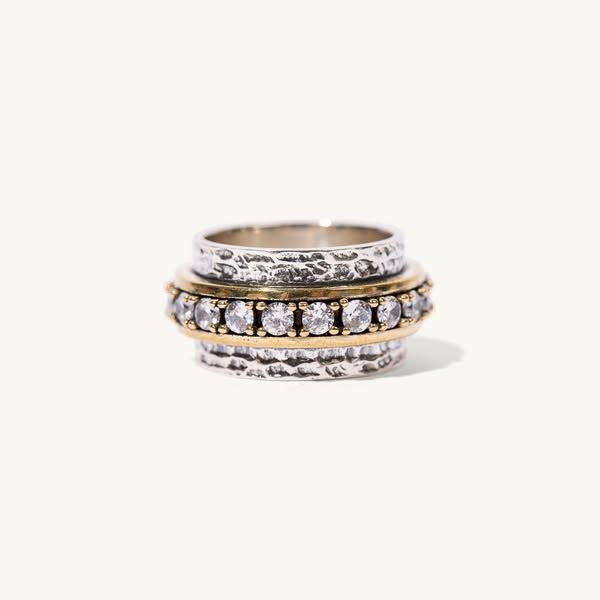
Creative pattern
Scarcity restock ad
Borrows credibility from a prior sell-out: the proof is that other people already bought it, and the urgency is a by-product.
Creative read
The only static in the set, and the only one whose hook depends on a prior event — you cannot restock what never sold out. Elongating 'BAAACK' does the work of an exclamation without one. Scarcity creative decays fast because the claim expires; this is worth studying as a mechanic to borrow, not a concept to run continuously.
Benchmark
The first-party performance read
Separate client benchmark — jewelry, August 2026
3.7×
Video to static ROAS index ratio in the qualifying client sample
Video 3.61% · Static 3.89%
Video returned 3.7x the return of static in the jewelry accounts we run
This performance benchmark is separate from the eight public creative teardowns. Across two Brenton Way-managed jewelry accounts in August 2026, video had a ROAS index of 225 versus 61 for static images, a 3.7X ratio. This describes the qualifying client sample, not the performance of the eight featured public ads.
$100+ spend, 3,000+ impressions and 2+ purchases during August 2026. The 14-ad sample contains 3 video ads, 10 static-image ads, and 1 catalog ad. The table compares video and static only; the catalog ad is excluded from that comparison. An index of 100 is the median qualifying creative in our own jewelry accounts for the month.
Method
How the creative set was selected
Study scope
150+ ad examples reviewed
United States DTC jewelry advertisers, creative in active rotation as of 3 September 2026
Meta publishes spend and impression ranges only for political and issue advertising, so no performance figures for the advertisers in this report are available to us or to anyone else, and none are claimed. Variant counts are a proxy for investment, not a measure of return. The only measured numbers on this page are our own, in the benchmark section.
Creative assets captured from each advertiser's live Meta Ad Library listing during the study window and reproduced at their original aspect ratio for commentary.
- #1 Scaling signal
- How many separate ads run the same creative and text. An advertiser duplicating one concept across multiple ads is putting budget behind a hook that is already working — the closest thing to a performance signal the Ad Library exposes.
- #2 Hook construction
- Whether the opening line does identifiable work — naming a problem, anchoring a price, conceding a weakness — rather than describing the product. Assessed by us against our creative rubric.
- #3 Currency
- In active rotation now, and launched recently enough to reflect what the category is testing this season rather than an evergreen holdover.