

Ask AI about this
Get an AI-powered summary of this article
Table of Contents
Most people have experienced geo-fencing without knowing it. You walk past a coffee shop and a notification appears on your phone. You drive near a car dealership and an ad follows you around the internet for the next three days. The technology is familiar. What's less understood is what it actually means when applied to out-of-home advertising.
In OOH, geo-fencing gets used to describe two very different things, and conflating them leads to a lot of confused briefs and disappointed clients. So it's worth being clear about what the term covers, what each application actually does, and where the genuine value sits.
Two things, one term: How to Use Geofencing for OOH Campaigns
The first application is using a geofence to decide which OOH screens get included in a buy. You draw a virtual boundary around a specific area, and only screens within that boundary are eligible to serve your ad. This is screen selection by geography, and it's fairly straightforward. If you're a retailer with three stores in a city, you might geo-fence around each location and only buy screens within a certain radius. Simple, logical, widely used.
The second application is more involved. Here, a geo-fence is drawn around an OOH screen or a set of screens. Anyone whose mobile device is detected within that boundary is added to an audience segment. That segment is then retargeted with digital ads on their phone or in their social feeds after they've been exposed to the OOH. This is the "mobile retargeting off OOH" use case, and it's where most of the industry excitement has been focused.
Screen selection by geography is planning. Mobile retargeting off physical exposure is attribution strategy. Both go by the same name, which causes more confusion than it should.
Understanding which one you're actually talking about changes what questions you should be asking, what you should expect to measure, and what your campaign structure needs to look like.
How the Retargeting Model Works in Geofencing Advertising
When a mobile device enters or exits a geofenced zone around an OOH screen, that device ID gets logged. The assumption is that the person holding the phone has seen, or had the opportunity to see, the billboard or screen in question. That device then becomes addressable in digital environments: social platforms, mobile apps, display networks.
The appeal is obvious. OOH has historically struggled with the last-mile problem: you can estimate how many people passed a screen, but you couldn't easily reach those specific people again with a follow-up message. Geo-fencing off OOH assets changes that, at least in theory.
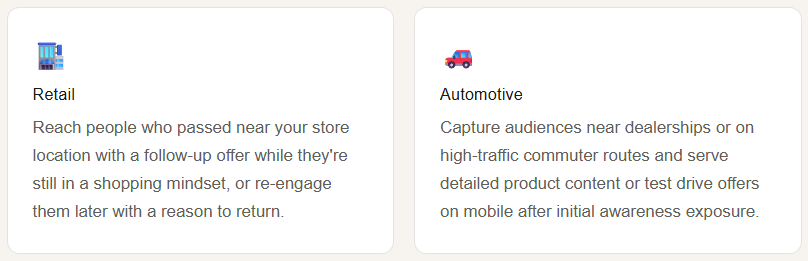
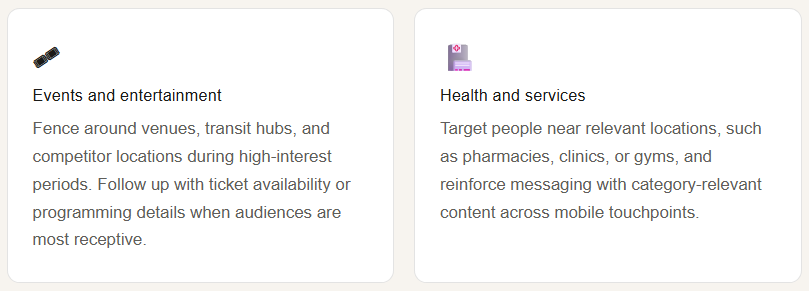
Done well, this creates a genuine multi-touchpoint sequence: broad awareness from the physical screen, followed by a more specific digital message that can carry more information, include a direct response mechanism, or just reinforce the brand impression. The out-of-home advertising campaign does the heavy lifting of reach; the mobile layer adds the follow-through.
The Assumptions Worth Questioning
The logic of geo-fencing off OOH sounds clean, but there are a few assumptions baked in that are worth examining before you commit a significant budget to it.
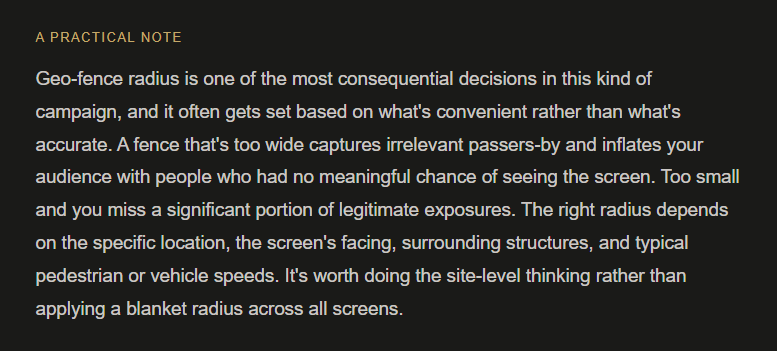
Physical proximity is not the same as visual exposure. A device detected within 100 meters of a billboard doesn't mean the person looked at it, or even had a clear sightline to it. They might have been on the other side of a building, sitting in a traffic jam facing the opposite direction, or walking with their head down. The geo-fence captures presence in a zone, not verified ad exposure. How large you draw the fence, and where exactly the screen faces, matters enormously for how much that assumption holds up.
Dwell time is often ignored. A device that passes through the fence zone for 30 seconds is treated the same as one that spent 20 minutes at a bus stop directly in front of the screen. Some platforms let you set minimum dwell time thresholds before a device is added to the retargeting pool. That's worth doing, though it significantly reduces the audience size.
Match rates vary more than vendors tend to advertise. Getting from a detected device ID to an addressable identity in a digital platform involves multiple handoffs. The match rate between the geo-fence audience and the retargetable pool on any given platform can range from strong to poor depending on the data partners involved, the market, and the platform. Ask for this number before you finalize the strategy.
Screen Selection Geofencing Done Properly
The simpler application, using geofences to select which screens to buy, deserves more attention than it gets. Most OOH planning conversations start with formats and audience indices. Geography often comes second. But for brands with specific catchment areas, flagging location-based constraints early saves a lot of time and money.
A fast food brand planning a value campaign doesn't need every screen in a city. It needs screens within a reasonable drive or walk of its actual restaurant locations. A local services business probably has no use for a premium roadside format on a motorway route that takes traffic away from its operating area. Geo-fencing the screen selection to relevant zones focuses the spend and usually improves proximity metrics without complicating the buy.
Where it gets more sophisticated is when you combine geographic screen selection with audience data. Programmatic DOOH platforms now allow you to layer location-based screen filtering with audience composition data, so you're not just buying screens near your geographic areas but screens near your locations that over-index for your target audience. That combination is where the real efficiency gains are.
For the inventory side of the buy, compare DOOH supply-side platforms before choosing partners.
Measurement and What You Can Realistically Expect
If you're running a geofencing marketing strategy off OOH screens, the measurement questions tend to come in two flavors: did the retargeting work, and did the OOH itself work?
The retargeting piece is relatively straightforward to measure in digital terms: click-through rates, conversion rates, cost per acquisition on the mobile layer. These are standard digital metrics and platforms can report them without much difficulty.
Proving the OOH contribution is harder. The most common approach is a holdout study, where a portion of the geo-fenced audience is excluded from the retargeting, and you measure the difference in conversion behavior between those who were retargeted and those who weren't. That gives you some signal on the incremental lift from the digital follow-up. It doesn't tell you cleanly what the OOH itself did independently of the retargeting sequence.
Foot traffic attribution tools have become more sophisticated and can help here, matching exposed device IDs to subsequent store visits. But these studies require volume to be statistically meaningful, and not every campaign has enough of it. Smaller regional campaigns often don't generate the sample sizes needed to draw reliable conclusions.
The honest answer is that attribution in OOH remains genuinely difficult, and geo-fencing improves the situation without fully solving it. Set expectations accordingly.
Privacy and The Data Landscape
This is a topic that can't be ignored. Mobile device tracking as a foundation for geo-fencing has been under sustained pressure from regulators, platform providers, and consumers. Apple's App Tracking Transparency framework significantly reduced the availability of IDFA-based location data. Android has moved in a similar direction. The mobile location data ecosystem is smaller and less reliable than it was three or four years ago, and that trend is continuing.
The vendors and platforms operating in this space have adapted to varying degrees, using modeled audiences, panel-based approaches, and first-party data integrations to compensate for the loss of direct device-level signals. The capabilities are still real, but the data inputs are more complex and the audiences are often modeled rather than directly observed. That's worth understanding when you're evaluating a vendor's methodology.
For regulated industries like finance, healthcare, and certain categories of consumer goods, there are additional compliance considerations around what location data can be used for and how audiences can be constructed. Getting legal involved early is worth the time it takes.
When It Makes Sense To Use Geofencing Marketing Strategies
Geo-fencing for OOH works best when there's a genuine strategic reason for the connection between the physical screen and the digital follow-up. A brand running a broad awareness campaign that adds geo-fencing retargeting as an afterthought is probably not getting meaningful value from the extra complexity. The budgets required for the mobile layer, the data fees, and the measurement infrastructure add up quickly.
Where it tends to deliver real value is in campaigns with clear geographic relevance, a specific action you want audiences to take, and a message that benefits from being reinforced across more than one touchpoint. A new store opening, a time-limited local offer, a competitive conquest strategy near a rival's location. These are cases where the logic is tight and the investment has a plausible path to payoff.
Tags
Let's Grow Your Brand With Us
Book a free consultation and get a custom growth strategy tailored to your business.
Book Free ConsultationGet marketing insights in your inbox
Join our newsletter for the latest digital marketing tips and strategies.
By subscribing, you agree to our Privacy policy .

About the author
Shreya S.Content Strategist at Brenton Way
Shreya S. is a Brenton Way content strategist specializing in ecommerce, consumer behavior, and programmatic advertising, translating market research into campaign-planning insights.

